Blog
Introducing Lookout, analysis to audience in minutes with agents
Introducing Lookout, analysis to audience in minutes with agents

Brooks Patterson
Head of Product Marketing
8 min read
November 10, 2026
If you’ve ever been the person in the gap between customer data and a marketing campaign, you know what it feels like to be a bottleneck, and being a bottleneck sucks.
At RudderStack we’ve spent the past seven years building the most powerful platform for customer data collection, governance, and unification. Data teams at companies like Vercel, Glassdoor, Foot Locker, and Lovable trust our core product to build their customer data foundation. But there’s been a gap between the data foundation and activation, that’s where the bottleneck lives.
Today that changes. We’re launching Lookout, an agentic suite for marketing teams that lets you go from “who should we target?” to live audience in minutes. You start with exploratory analysis and end with an audience syncing to your ad platforms, CRM, and engagement tools, all in one session, in minutes.
Lookout is now generally available and can be purchased standalone or alongside our core app. You can keep reading if you want more details, or you can sign up for free and explore the sandbox to see its power for yourself.
It shouldn’t take weeks to get marketing data
Fragmented. Chaotic. Slow. Manual. Disjointed. These are all words our customers used to describe the process of getting data for their marketing campaigns.
The bottleneck is real because the comprehensive data needed for precise targeting lives in the data warehouse, and if you're a marketer, you can’t easily access and explore warehouse data – that’s simply not your job. So you depend on someone from the data or Ops team.
You’re all familiar with the process. It involves handoffs between marketing and data, back and forth, SQL, CSV exports (PII nightmare 😬), and manual audience uploads, and it can take multiple weeks from start to finish. That’s no fun for anyone.
For data teams it means having all of your plans ruined by ad hoc requests, as Ryan Dolley, a veteran data leader and one of our launch partners, put it.
For Marketing teams, it means stalled campaigns, sure, but there’s another sneaky cost. Without access to explore data yourself, you can only be so creative with your campaigns. You simply don’t know what you don’t know.
With Lookout, I can empower my whole team to be curious, to answer questions themselves, and build campaigns around the answers
Meghan Hilton
RevOps and Lifecycle Marketing Leader, PrizePicks
That’s why with Lookout we didn’t just want to solve the building part of audience activation. We wanted to give every marketer, from the MarketingOps lead to the paid media specialist to the lifecycle team, the ability to explore warehouse data themselves and quickly build audiences from their analysis.
More than just building audiences
Lookout isn’t just an audience builder, because the hardest part of targeting isn’t building the audience. It’s figuring out who belongs in it and getting it where it needs to go reliably, with fresh data.
Lookout does it all with a team of agents in a unified workflow. It enables anyone to explore data in the warehouse, build audiences, and activate them downstream. Here’s the core workflow:
Analyze
UI audience builders are great if you know exactly who you want to target. But not every campaign idea comes with a clear prescription. Often, you need to do some exploratory analysis first, and this is where Lookout really shines.
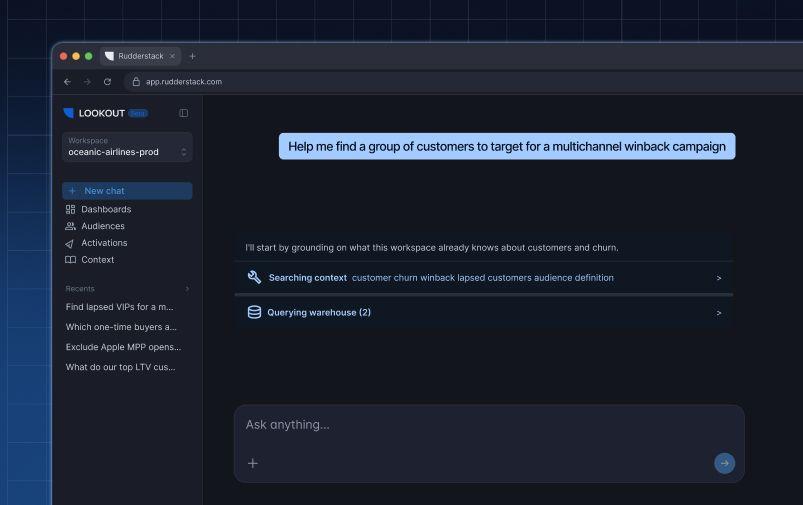
Start with a vague prompt like “I want to run a winback campaign, help me find a group of customers to target.” and Lookout will go to work. It reasons over all the data in your warehouse (not just the slice that makes it into downstream marketing tools) and comes back with suggestions. You can go back and forth with the agent as your copilot to drill deeper and continue exploring. Once you find the segment you want to target, you can turn it into an audience instantly.
Build
You don’t have to write any SQL or configure anything manually in a UI, after you identify the audience you want to target, Lookout creates the audience for you. But it’s not a black box. If you want, you can inspect the SQL it writes, and it exposes the audience in a familiar audience builder UI where you (the human in the loop) can audit your audience and make further refinements. From there, activation is just a step away.
Activate
Once you’ve dialed in your audience, you can sync it downstream to your ad platforms, CRM, and customer engagement platforms with a few clicks. Lookout handles the field mappings for you, and you can set sync times as frequently as every five minutes. The direct warehouse connection eliminates CSV exports and manual uploads, and ensures every tool works from the same audience definitions with fresh data so targeting and suppression stays current as people enter and leave segments.
That’s it. Analyze, build, and activate. Without filing a ticket for your data team or sending an annoying request in Slack. Without any human writing SQL. Without any CSVs floating around full of PII. And it all happens in one session in a matter of minutes.
Acting on a new campaign idea used to take weeks. We'd make a request with our analytics team, wait for them to do analysis, add custom attributes if needed, and sync the data to Braze. Lookout eliminates the back and forth. Now my team can launch campaigns faster than ever.
Meghan Hilton
RevOps and Lifecycle Marketing Leader, PrizePicks
Can you really trust audiences from agents?
Agents can’t build precise audiences on raw warehouse tables alone. That’s why we built context into the fabric of Lookout, so all of your analysis and your audiences are built on your data team’s definitions and grounded in business knowledge, not guesswork. Lookout’s context hub lets you teach Lookout about your business, and context integrations give Lookout context about your data.
Context integrations
Lookout connects to the modeling code and semantics your data team already maintains, so analysis and audiences are always based on trusted metrics from the right tables.
- Github integration: Lookout can automatically generate (and refresh!) documentation from your dbt, LookML, or cube modeling code, so it knows how your tables are built and what each column means.
- Semantic layer integrations: Connect Lookout to Snowflake semantic views and Databricks Unity Catalog metric views, so it builds every audience on the certified metrics and business definitions your company already trusts.
Context hub
In Lookout’s context hub, you teach Lookout about your business and how your team works. Context hub includes three features:
- Notes: Notes are text files where you can document your business model, ICP, marketing strategy, and team conventions, so Lookout builds with a deep understanding of your business and how your team operates.
- Skills: Skills are, well skills, you can use them to turn your team’s standards, like checks every audience should pass, into rules Lookout follows every time for everyone.
- Memories: Memories are notes Lookout generates automatically as it learns more about your data and how your team works so your context compounds and Lookout gets smarter as you use it.
With you wherever you go
With Lookout’s Slack integration and the Lookout MCP you can get the power of Lookout in the tools you already live in day to day. Add Lookout to Slack, and everyone on your team can ask questions, build charts, and get answers. You can DM the Lookout app directly, but the real power comes from adding Lookout to shared channels. Anyone can @lookout to ask questions, creating a culture of collaborative curiosity.
And with the MCP, you can connect Claude, Cursor, Codex, or whatever MCP client you use to ask questions, build audiences, and send them to your ad platforms (with all the same context from the web app).
Get started
If your marketing campaigns regularly get stuck waiting for targeting data, there’s a better way. Lookout is now generally available, and you can replace the bottleneck with a fast, unified workflow.
To see its power firsthand right now, sign up free and explore the sandbox. If you want to do a deeper dive with our team, reach out and request a demo.
Published:
November 10, 2026



Get started today
Start driving better business outcomes with your customer data in less than a week
Book a demo
Explore use cases with an expert and see RudderStack in action.
Implement RudderStack
Start collecting and enabling real-time customer data everywhere it's needed.
Drive better outcomes
Supercharge your analytics, product, growth, and AI teams.