Blog
What is entity resolution? Use cases and best practices
What is entity resolution? Use cases and best practices

Pradeep Sharma
Developer Relations
16 min read
January 20, 2026
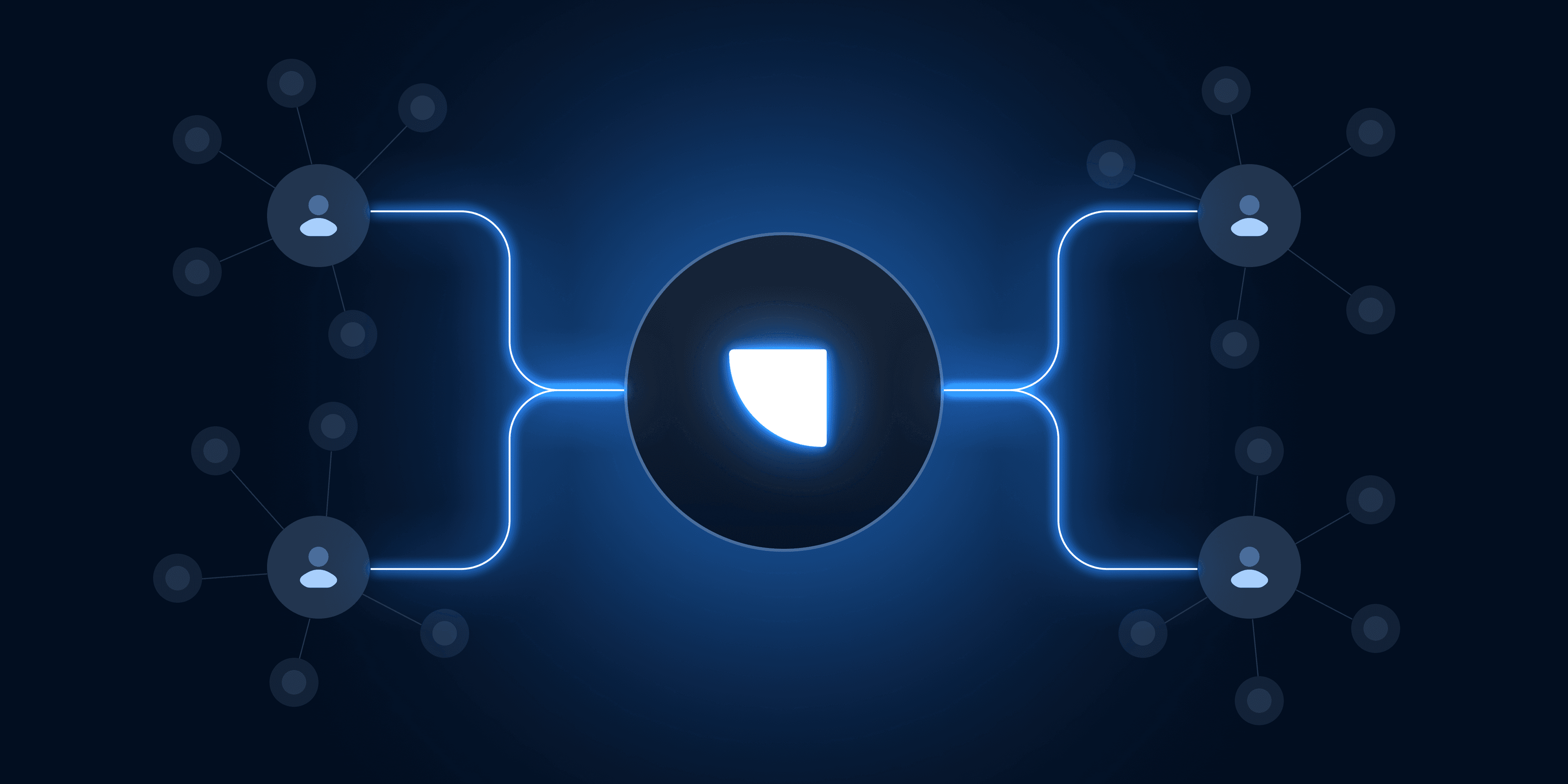
Every business ends up with data that doesn't match up. Different names, addresses, or emails for the same customer are scattered across dozens of systems. Without entity resolution, you never really know who's who in your data.
Entity resolution connects the dots, linking separate records to give you a single, trusted view of each person or company. If you want to make better decisions and deliver great experiences, understanding entity resolution is where you start.
Main takeaways:
- Entity resolution links fragmented records across people, accounts, products, or households to create unified, accurate profiles that improve decision-making and analytics
- Identity resolution is a subset of entity resolution focused on unifying customer records to build a single view of the individual for marketing and personalization
- Businesses use entity resolution to improve data quality, streamline operations, enhance compliance, and provide consistent customer experiences
- The process involves preprocessing data, applying deterministic and probabilistic matching techniques, and linking profiles with confidence scoring and survivorship rules
- Use cases range from CRM, marketing, and churn prediction to fraud detection, master data management, supply chain tracking, and healthcare data unification
What is entity resolution?
Entity resolution, or entity matching, is the process of linking records that represent the same real-world entity, such as a person, company, or household, across different data sources.
Resolving duplicates and inconsistencies creates a single, accurate record that improves data quality and supports master data management (MDM). For example, in a grocery delivery company, entity resolution could connect multiple interactions from different household members into one unified profile, enabling better decision-making, customer service, and sales.
This ensures organizations gain a complete, trusted view of their entities across systems.
Build your foundation with behavioral data
Understanding entity resolution starts with good data—explore how behavioral analytics feeds clean identity linking with our guide.
Entity resolution vs. identity resolution
Identity resolution is often discussed in marketing and customer data contexts, but it's really a subset of the broader practice of entity resolution.
- Identity resolution focuses specifically on individuals — deduplicating customer records and unifying identifiers to create a single view of each person. This is what powers "Customer 360" initiatives and is often the promise of customer data platforms.
- Entity resolution covers a wider scope. Beyond individuals, it can unify records for households, business accounts, product SKUs, or even devices. The goal is to connect disparate data points to form a consistent and complete view of whatever entity matters most to your organization.
While the techniques are largely the same (data matching, record linkage, fuzzy algorithms, and ML models), the scope differs. Identity resolution supports personalization and marketing analytics, while entity resolution extends into broader domains like master data management, compliance, and operational efficiency.
If your organization has the capability to perform entity resolution in its data warehouse, you already have the foundation for identity resolution. The difference lies in which entities you choose to model and unify.
Why entity resolution matters for business
Poor data quality costs organizations an average of $12.9 million annually, according to Gartner. In fact, 94% of businesses suspect that their customer and prospect data is inaccurate, highlighting how widespread the issue really is. Entity resolution directly addresses this challenge by eliminating duplicates and connecting related records across people, products, accounts, or other entities.
Here's how entity resolution can help any organization:
- Accurate data analysis and decision making: Entity resolution ensures that each entity (whether a customer, product, or supplier) is unique and distinct in a database. This clarity is essential for accurate analytics and avoids misleading insights.
- Enhanced customer experience: When applied to customers, entity resolution enables identity resolution—accurately linking customer data to create personalized services, recommendations, and support.
- Efficient data processing: By resolving duplicates and inconsistencies across entities, organizations streamline data pipelines, saving time and resources in management and analysis.
- Compliance and risk management: In regulated industries, entity resolution helps accurately identify individuals or accounts, aiding in fraud detection, KYC/AML processes, and compliance reporting.
- Enabling advanced technologies: AI and machine learning require high-quality input. Entity resolution ensures clean, structured data — whether it's about customers, products, or transactions — that improves model accuracy.
- Data integration: In cases where data is collected from multiple sources, entity resolution helps in merging and reconciling this data effectively, providing a unified view that is crucial for comprehensive analysis.
- Cost savings: Following the "1:10:100 rule" in data quality, resolving entities at the point of entry is more cost-effective than correcting or dealing with the consequences of unresolved data later. This proactive approach saves significant costs related to data cleanup and the fallout of poor-quality data.
Table: Before and after entity resolution
Before and after entity resolution | Before | After |
|---|---|---|
Duplicate records, incomplete profiles | ✔️ | ✗ |
Single, unified records | ✗ | ✔️ |
Fragmented customer view | ✔️ | ✗ |
Complete customer view | ✗ | ✔️ |
Manual deduplication effort | ✔️ | ✗ |
Automated matching | ✗ | ✔️ |
How does entity resolution work? Three key steps
Entity resolution follows three main steps to connect and unify records across disparate data sources.
1. Data preprocessing
First, you need to prepare your data for matching. This involves cleaning, standardizing formats, and parsing complex fields into components to create a consistent foundation for comparison.
- Cleaning: Remove errors, fix typos, eliminate duplicates, and handle missing values that could interfere with matching
- Standardization: Apply consistent formats for names (uppercase/lowercase conventions), addresses (street abbreviations), phone numbers (country codes), and dates (MM/DD/YYYY vs. DD/MM/YYYY)
- Parsing: Break down complex values (like full names into first/middle/last, or addresses into street/city/state/zip) to enable field-level comparisons
For example, "John A. Smith" and "Smith, J." could be standardized to "JOHN SMITH" in the matching database while preserving the original format in display fields, enabling more accurate matching despite presentation differences.
2. Matching techniques
Entity resolution relies on different techniques to identify and unify records, each with its own strengths and limitations.
- Deterministic (rules-based) matching: Uses exact identifiers such as email addresses, customer IDs, or government-issued numbers to link records with high confidence. It's simple, fast, and efficient when identifiers are complete and consistent, making it ideal for structured datasets or straightforward use cases. For example, if two records share the same tax ID, they can be confidently merged.
- Probabilistic (statistical or ML-based) matching: Estimates the likelihood that records refer to the same entity, even when identifiers differ across systems or formats. This approach considers multiple attributes (e.g., names, addresses, dates of birth), accounts for typos or phonetic variations, and assigns confidence scores to potential matches. Algorithms like Levenshtein distance, Soundex, or Jaro-Winkler are often used here to detect near-duplicates, such as "Jon Smith" and "John Smyth." Probabilistic approaches are especially valuable at enterprise scale, where data is messy, incomplete, and inconsistent.
3. Linking and profiling
Finally, the system links matched records and builds unified profiles that represent the single source of truth for each entity.
- Score generation: Assigns confidence levels (typically 0-100%) to potential matches based on the quality and quantity of matching attributes, with higher weights given to rare or unique values
- Threshold evaluation: Sets rules for automatic acceptance (e.g., >90% confidence), rejection (<50%), or manual review (50-90%) based on business risk tolerance and data quality
- Entity profiling: Merges matched data into comprehensive records, applying survivorship rules to determine which values to keep when conflicts exist (e.g., most recent phone number, most complete address)
Machine learning techniques can improve this process by learning from previous matches and user feedback. Models like Random Forest, SVM, or neural networks can detect subtle patterns in how entities match, handling complex cases like cultural name variations or address changes. This makes the system more accurate over time, particularly for edge cases that rule-based systems struggle with.
Top use cases for entity resolution
Entity resolution powers a wide range of applications, depending on which entities are most critical to a business. While identity resolution for customers is the most common, the same techniques apply to many other contexts.
Customer-focused use cases (identity resolution):
- Customer relationship management (CRM): Prevent duplicate or fragmented records in CRM systems by consolidating identifiers into a single customer profile. This ensures sales and service teams see the full history of each customer, from purchases to support tickets.
- Marketing and sales analytics: Link interactions across web, mobile, and offline channels to create unified customer journeys. Marketers gain better attribution, segment audiences more accurately, and deliver more effective campaigns.
- Churn prediction and personalization: Build reliable customer profiles that power machine learning models for predicting churn risk and estimating lifetime value. Personalization engines can then recommend the right offers and experiences at the right time.
Enterprise and compliance use cases:
- Fraud detection, compliance, and regulatory reporting: Detect suspicious activity by linking accounts, transactions, or identities that appear unrelated. Entity resolution helps with KYC (Know Your Customer), AML (Anti-Money Laundering), HIPAA, and other compliance obligations by ensuring accurate, consolidated records.
- Master data management: Maintain a single, authoritative version of customer, product, and supplier data across business units. Entity resolution reduces duplication, improves governance, and creates a trusted source of truth for the enterprise.
- Healthcare data management: Merge patient records across providers, EHR systems, or insurance databases to create accurate, unified medical histories. This improves care coordination, reduces medical errors, and enables better outcomes research.
- Supply chain management: Track parts, products, and components across systems to eliminate duplication and ensure accurate traceability. Entity resolution supports efficiency, regulatory compliance, and proactive risk management in complex supply chains.
Analytics and research use cases:
- Machine learning and AI training: Clean, deduplicated, and unified datasets improve the accuracy and reliability of predictive models. Entity resolution ensures that training data isn't skewed by duplicate records or missing links.
- Social network analysis: Reveal relationships between individuals, teams, or organizations by linking disparate records. This is useful for market research, political campaigns, and academic or social science studies where understanding connections is key.
Common types of entities
The types of entities that matter most will vary depending on a company's business model. In consumer-facing businesses (B2C), the focus is typically on the individual customer, since they are the primary buyer of products or services. In business-to-business (B2B) contexts, however, the focus shifts toward business accounts and client organizations, which often include multiple users, teams, and layers of relationships.
For example, a company that sells pet food online might even treat each pet as a separate entity, linking them to their owner's profile to deliver targeted recommendations for pet-specific food or care products.
Common focal points for B2C businesses include:
- Individual customers
- Products purchased or subscribed to
- Ongoing subscription services
Common focal points for B2B businesses include:
- Individual users within a company
- Project or work teams
- Client organizations or parent accounts
Understanding which entities matter most, as well as how they relate to one another, is a critical foundation for effective entity resolution.
Entity resolution in B2B contexts
While many examples of entity resolution focus on individual customers, it is just as critical in B2B environments, where interactions often span multiple levels of users, teams, and accounts.
Consider a fictional company, DataStream, which tracks a wide range of entities related to its product suite and customer base:
- Product-related entities: software solutions, data streams, integration tools, output formats, sync processes
- User-related entities: individual users, customer accounts, project teams, client companies
To understand how a client company engages with its services, DataStream must resolve identities across all of these entities. For example, linking individual logins to a project team, connecting project teams to a parent client company, and tying those interactions back to product usage. By aggregating these layers, the company gains a 360-degree perspective on how customers interact with their platform.
This B2B approach ensures consistent reporting, improves deal-making, and helps teams align sales, product, and customer success around the same source of truth.
Resolve complex B2B relationships with RudderStack
Unify users, teams, accounts, and parent companies in real time with deterministic, fuzzy, and ML-based matching—all while maintaining full privacy and compliance. Explore RudderStack Profiles
Seven best practices for entity resolution
Follow these guidelines to implement effective entity resolution.
1. Start with strong data quality
Quality input data is essential for accurate matching. Standardize formats, validate entries, and automate checks for duplicates or missing fields.
- Data validation: Implement rules to catch inconsistencies before they enter your systems
- Format standardization: Create consistent formats for names, addresses, and other key fields
- Quality monitoring: Track data quality metrics to identify issues early
2. Use entity relationship diagrams to model entities
Before implementing resolution rules, map out the entities and their relationships visually with an entity relationship diagram (ERD). This helps clarify how individuals, accounts, households, or products connect, and ensures your data model reflects real-world relationships.
For example, a SaaS company might map users to project teams, teams to client accounts, and accounts to parent companies. ERDs guide which identifiers matter most at each level and help align your resolution process with broader MDM strategies.
3. Implement hybrid matching approaches
A best practice for entity resolution is to combine deterministic and probabilistic methods rather than relying on one alone.
- Use deterministic first: Apply exact rules with strong identifiers (like IDs or emails) to quickly merge high-confidence matches.
- Layer probabilistic methods: For records with incomplete or inconsistent data, use similarity scoring, fuzzy algorithms, or ML models to estimate match likelihood.
- Set thresholds wisely: Define clear bands for auto-merge, manual review, and reject, adjusting them to your industry's tolerance for risk.
- Continuously improve: Feed reviewer decisions and new data patterns back into your models to refine accuracy over time.
- Keep compliance in mind: Ensure matching respects consent, deletion rights, and data minimization requirements.
This hybrid strategy balances speed and certainty from deterministic rules with the flexibility and coverage of probabilistic matching.
4. Scale for high-volume processing
As data volumes grow, your entity resolution system must scale efficiently:
- Use cloud-native architectures for distributed processing
- Implement incremental updates to process only changed records
- Partition data strategically to optimize performance
RudderStack's infrastructure is designed to handle high event volumes while maintaining low latency, making it ideal for real-time identity resolution.
5. Establish human-in-the-loop reviews
Even the best systems struggle with ambiguous edge cases. Design workflows where unresolved matches are flagged for manual review. Define thresholds for when human oversight is required (e.g., <70% match confidence). Train reviewers to apply consistent rules when verifying or rejecting matches.
6. Incorporate privacy controls
Entity resolution often involves sensitive personal data. Implement strong privacy safeguards:
- Apply data minimization principles
- Use pseudonymization for sensitive attributes
- Automate consent management across systems
- Implement field-level encryption where appropriate
7. Monitor and improve continuously
Monitoring and improving your process is critical. Track metrics like precision, recall, and F1 score for your matching system.
Incorporate user feedback or downstream error reports into iterative improvements. Build scalable logging and observability to detect drift or sudden spikes in unresolved matches.
See entity resolution in action
Learn how RudderStack helps unify fragmented data into trusted profiles for personalization, fraud detection, and analytics at scale.
Common tools for entity resolution
These tools and companies help businesses accurately identify and link data across different sources and formats.
Data integration and quality tools
These platforms are designed to manage large-scale data pipelines, improve data quality, and provide governance capabilities. Entity resolution is typically one feature within their broader integration and management offerings, making them well-suited for enterprises that need end-to-end data infrastructure.
- Informatica: Broad integration and quality suite with built-in entity resolution.
- IBM Entity Analytics: Part of IBM's analytics portfolio, emphasizing data quality and insights.
- SAS Data Management: A Comprehensive platform with entity resolution features for governance and integration.
- Talend Data Quality: Open-source–friendly suite offering matching and resolution within its integration services.
Machine learning and AI-driven solutions
These solutions leverage advanced algorithms and ML models to detect complex relationships, scale across large heterogeneous datasets, and improve accuracy over time through feedback loops. They are ideal for organizations with diverse, high-volume data and evolving entity resolution requirements.
- Tamr: Applies machine learning to large, heterogeneous datasets for scalable entity resolution.
- Senzing: Specializes in AI-powered resolution, revealing hidden relationships to enhance analytics accuracy.
Specialized entity resolution and matching
These tools focus specifically on deduplication and record matching tasks. They're often lightweight, easy to deploy, and tailored to specific domains like marketing or CRM, making them a strong fit for teams that need straightforward resolution without the overhead of a full data platform.
- Dedupe.io: Lightweight deduplication tool tailored for smaller datasets and straightforward resolution tasks.
- Data Ladder: Focused on marketing, CRM, and MDM use cases with robust data matching capabilities.
Real-time identity resolution in the data stack
A newer category of tools is emerging that embeds entity resolution directly into the modern data stack. Instead of requiring separate platforms, these solutions allow data teams to unify customer identities in real time while maintaining strict control over privacy, governance, and scale. They're designed for organizations that prioritize transparency, flexibility, and first-party data ownership.
- RudderStack: Provides real-time identity resolution as part of its customer data infrastructure, enabling engineers to unify fragmented identities within their own cloud environment while enforcing privacy and governance policies
Unify identities with RudderStack
Entity resolution is essential for creating trusted customer profiles that power analytics and personalization. As data volumes grow and privacy regulations evolve, implementing robust entity resolution becomes increasingly important.
RudderStack provides the infrastructure for secure, real-time identity resolution. By unifying data across your stack while maintaining privacy and compliance, you gain a reliable view of each customer.
Ready to build unified customer profiles? Request a demo to see how RudderStack can help.
FAQs about entity resolution
Entity resolution techniques include deterministic matching using exact identifiers, fuzzy matching for similar records, and probabilistic methods that calculate match likelihood based on multiple attributes.
Entity resolution helps detect fraud by connecting seemingly unrelated accounts or transactions that share subtle patterns, revealing hidden relationships that may indicate fraudulent activity.
Entity resolution machine learning adapts to your specific data patterns and improves accuracy over time by learning from previous matches and feedback, unlike static rule-based approaches.
Modern entity resolution tools connect to your data warehouse, lake, or other repositories through APIs or direct integrations, processing data either in batch mode or real-time depending on your needs.
Published:
January 20, 2026



Get started today
Start driving better business outcomes with your customer data in less than a week
Book a demo
Explore use cases with an expert and see RudderStack in action.
Implement RudderStack
Start collecting and enabling real-time customer data everywhere it's needed.
Drive better outcomes
Supercharge your analytics, product, growth, and AI teams.