Blog
How to assemble and serve fresh customer context with RudderStack
How to assemble and serve fresh customer context with RudderStack

Brooks Patterson
Head of Product Marketing
8 min read
February 3, 2026
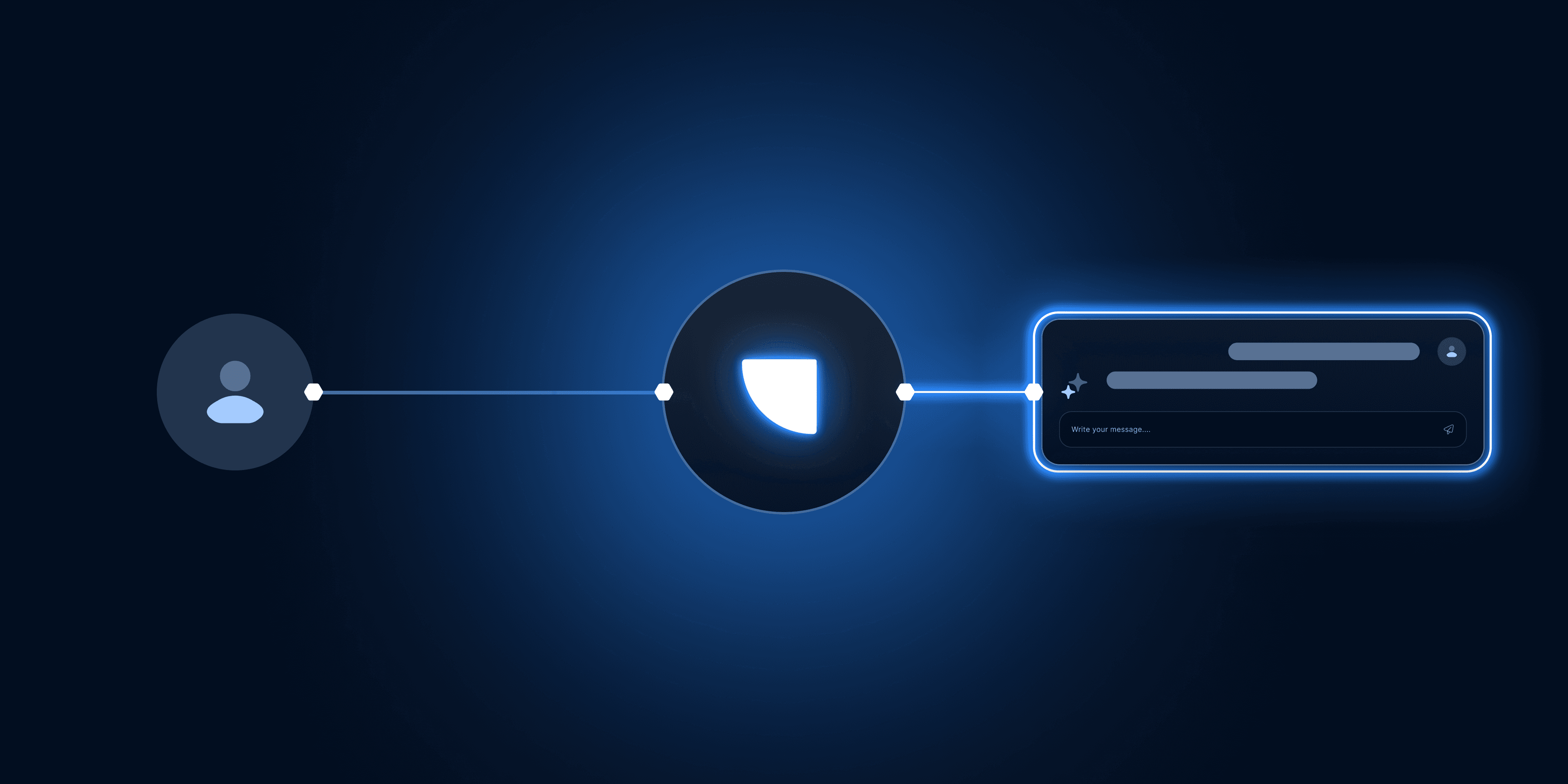
Customer-facing AI experiences are moving from pilot to production and proving their value with demonstrable ROI. The race is on. Teams are pushing to deliver production-ready systems that can reliably deliver impactful customer experiences, and customer context is front and center.
With on-demand access to fresh, trustworthy customer context, LLMs can return accurate, relevant answers and personalize experiences based on real intent signals. When that context is missing or stale, models have incomplete data to work with, and they return bad answers that frustrate customers and destroy trust.
Put sharply: Customer-facing AI with strong customer context is a huge competitive advantage. Customer-facing AI without strong context isn’t just neutral, it’s a major liability that will tank conversion, increase support burden, and drive churn.
In this post, we'll break down the end-to-end data architecture you need to assemble and serve fresh customer context to your AI experiences, and we’ll show you how RudderStack supports every step of the way. This is the foundation.
We'll explore context engineering best practices and advanced serving patterns in future posts.
What is customer context?
First, let’s define customer context. Before the AI revolution, there was customer 360, which is a comprehensive, unified view of every available data point for a given customer. In the AI era, the focus is on customer context, a manifestation of the customer 360 that includes all of the use case relevant data about the customer that can help the agent make decisions. It can be a precomputed snapshot, or in more advanced implementations it may be assembled on demand by the AI agents.
The customer 360, and the customer context derived from it, is built from a mix of different data sources and types:
- First-party behavioral (clickstream) data: Observed user actions across products, websites, servers, and SaaS tools. This is high signal, continuously generated data that captures intent through patterns of behavior.
- First-party operational data (structured): Stateful customer records and transactions from systems like CRMs, billing, support, and ERPs. This data reflects durable business state and evolves through discrete updates.
- First-party operational data (unstructured): Communications and recordings from customer interactions, including chat transcripts, email exchanges, support call logs, and video recordings. This data captures nuanced context and sentiment, but requires distinct processing approaches from structured operational data.
- Second and third-party enrichment data: Supplemental customer data from external systems or vendors , such as ad platforms, fulfillment services, and third-party data providers, that adds context not directly observable through first-party interactions.
For many generative AI use cases, clickstream data is a force multiplier. It contains critical signals of engagement and intent, and when LLM responses are aligned with customer intent, magic happens. So, how do you assemble and serve customer context to make this magic happen?
Assemble and serve: Real-world customer context architecture
A lot has to happen behind the scenes for your customer-facing AI to deliver positive experiences and results. The key is getting fresh, trustworthy customer context to your AI at exactly the right moment. That requires two coordinated workflows: assembly and serving.
Assembling customer context for generative AI
Building customer context follows a familiar data engineering pattern: Collect raw data from source systems, land it in your warehouse, clean and model it into a unified customer view, then derive the features your AI needs to reason effectively. The core components are:
- Source systems: These map to the data sources we covered above and will vary by your company and use case.
- Data pipelines: Streaming pipelines for clickstream data, ETL pipelines for operational and enrichment data.
- Storage system of record: The data warehouse / lakehouse where data lands and gets modeled.
- Modeling layer: Where you stitch identities, derive features (computed traits), and build predictive models for propensity scores like LTV and churn.
⚡ Fresh or real time?
For the majority of use cases, assembly needs to happen fast enough to keep data fresh (current enough for the use case), but it does not have to happen in real time. What’s critically important is that serving does happen in real time or on demand. Advanced use cases do call for real time serving and assembly. This requires a different architecture, which we’ll cover in a future post.
Once you’ve assembled the context in the warehouse, it’s time to make it available on demand.
Serving customer context on demand for customer facing AI experiences
The serving workflow is where data teams and application engineers collaborate to make customer context available, safely and reliably, at the moment an AI system needs it. The core components are:
- System of record: The data warehouse / lakehouse where data lands and gets modeled. Now the source system for the customer context serving layer.
- Key-value store: An in-memory data store that holds precomputed customer context snapshots for low-latency access. This is required when the underlying data-warehouse / lakehouse isn’t suitable for low latency access.
- API to fetch customer context: An interface to retrieve and return structured customer context to the calling service.
- LLM orchestration layer: The service that coordinates context injection and interaction with the language model. Customer context must integrate with the system's memory management framework. While short-term memory handles ephemeral conversation state, customer context belongs in long-term memory as persistent context.
Here’s how the serving workflow fits together: Customer context is precomputed in the warehouse and materialized as a snapshot, which is then synced to a key-value store for low-latency access. This makes the context available to the serving layer on demand.
When a user interacts with the AI experience, the application calls the customer context API, passing a session-derived user identifier. The API uses that identifier to retrieve and return the corresponding context snapshot. The LLM orchestration layer incorporates this context during prompt assembly and invokes the language model, which generates a response that is delivered back through the user-facing application.
In basic implementations, context is fetched once at the start of an interaction (or session) and reused throughout.
In agentic implementations, the AI retrieves context incrementally via tool calls, fetching only the specific customer data required for the current step (from precomputed snapshots or on-demand warehouse queries rather than loading everything upfront). This is typically better because it keeps context smaller and more relevant, stays fresher as the user’s state changes, and avoids unnecessary data loading, which improves reliability while controlling latency and cost when combined with caching and query budgets.
🚀 Advanced context serving
With a real-time analytical warehouse, you don’t need a separate in-memory store or heavily precomputed snapshots. Instead, you can build an application function that queries the warehouse at inference time and returns structured context directly to the LLM.
RudderStack: The customer context engine for the AI era
There is a lot that has to happen behind the scenes for customer facing AI to make magic. Luckily, RudderStack supports and simplifies workflows for both assembling and serving customer context. Here’s how:
- Event Stream simplifies the process of collecting clickstream data from websites and applications with pre-built SDKs and robust warehouse integrations.
- Profiles automatically builds an identity graph in your warehouse with all of your clickstream, operational, and enrichment data to produce a customer 360. It also makes it easy to build features and add computed LTV and churn scores.
- Activation API automatically syncs your customer 360 to redis and provides an out-of-the-box mechanism for serving customer context.
- Data quality and data compliance toolkits enable you to proactively manage governance throughout your streaming pipelines, so only clean compliant data makes it to the warehouse.
Our combination of products and warehouse-native, data team-first fundamentals make RudderStack the fresh, trustworthy customer context engine for the AI era.
Conclusion
If you’re building AI-powered customer experiences, they won’t deliver a competitive advantage without on-demand access to fresh, trustworthy customer context. Without it, even the most sophisticated models struggle to produce accurate, relevant, and action-driving interactions.
Building the full context assembly and serving workflow from scratch is possible. But it’s time-consuming, complex, and distracts teams from focusing on the experiences that actually differentiate their business.
RudderStack simplifies the hardest parts of this problem, from real-time data collection and identity resolution to governed context delivery, while integrating cleanly with the rest of your AI and application stack.
But you don’t have to take our word for it.
Join our upcoming webinar to see how iVendi uses RudderStack, ClickHouse, and Vercel to implement an advanced context serving workflow end to end, powering a highly personalized, AI-driven chat experience in production.
Published:
February 3, 2026
More blog posts
Explore all blog posts
Stop flying blind: Real-time JavaScript SDK debugging with the RudderStack Tracking Assistant
Drew Dodds
by Drew Dodds

Data without compromise: The RudderStack story
Danika Rockett
by Danika Rockett

Snowflake Summit 2025 recap: Launches, live demos, and real-time data
Ricky Spiese
by Ricky Spiese


Start delivering business value faster
Implement RudderStack and start driving measurable business results in less than 90 days.