Self-host JavaScript SDK in Your CDN
4 minute read
RudderStack recommends serving the JavaScript SDK on your own domain over self-hosting it, especially to defend against the adblockers.
Self-hosting the SDK is only recommended in cases where you want to create a zero-gap architecture and ensure no data goes out to any external service.
This guide walks you through the steps for self-hosting the RudderStack JavaScript SDK.
Prerequisites: Directory structure
For self-hosting the JavaScript SDK, RudderStack recommends following the below directory structure (as present in RudderStack’s CDN) to place the SDK and the associated files:
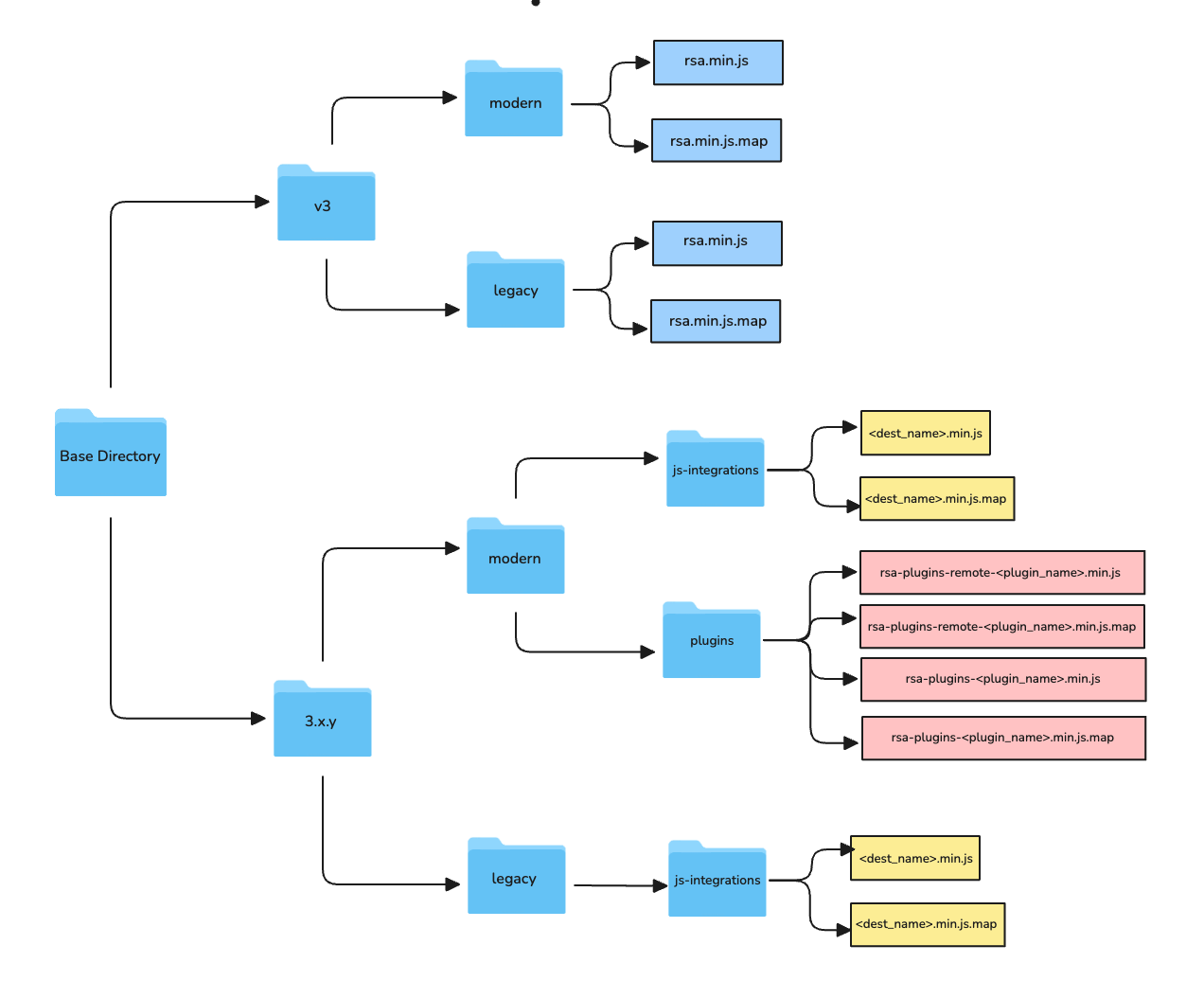
In this structure, there are two directories - v3 and 3.x.y (denoting the specific SDK version) - within the base directory.
| Folder name | Description |
|---|---|
| v3 | Contains the core SDK files - rsa.min.js and rsa.min.js.map. |
| 3.x.y | Contains the device mode integrations and plugins. |
Each of the above folders folders has two subdirectories - modern and legacy.
The SDK bundle in the modern directory is built for ES2015, while the legacy bundle is for ES5, with all the plugins bundled into the core SDK.
The modern folder within 3.x.y further contains the following subdirectories:
| Folder name | Description |
|---|---|
| js-integrations | Directory for storing the device mode destination SDKs. |
| plugins | Directory for storing the plugins. |
Setup
RudderStack recommends downloading and hosting all the device mode destination SDKs, plugins, and source map files to help with troubleshooting.
1. Download core SDK files
Download the JavaScript SDK and save it as rsa.min.js. Also, download the corresponding source map file, and save it as rsa.min.js.map.
Note that the above URLs point to the latest version of the SDK (v3).
To download the latest SDK version, replace
v3in the URL with the required SDK version.For example, the URLs for fetching the
rsa.min.jsandrsa.min.js.mapfiles for the SDK v3.15.1 would be as follows:https://cdn.rudderlabs.com/3.15.1/modern/rsa.min.js https://cdn.rudderlabs.com/3.15.1/modern/rsa.min.js.map
Then, place these files in the v3 > modern / legacy folder within your base directory, as applicable.
2. Download device mode integrations
Download the required device mode destination SDK files along with the corresponding source map file from the RudderStack CDN (https://cdn.rudderlabs.com/) using the below URL:
https://cdn.rudderlabs.com/3.x.y/<bundle>/js-integrations/list.htmlIn the above URL, make sure to replace:
3.x.ywith the required SDK version.<bundle>with the desired SDK bundle (modernorlegacy).
For example, the URL to download the device mode integrations for the modern bundle for SDK v3.15.1 would be as follows:
https://cdn.rudderlabs.com/3.15.1/modern/js-integrations/list.htmlThen, place the downloaded files in the 3.x.y > modern / legacy > js-integrations folder, as applicable.
3. Download plugins
This section is applicable only for the modern bundle.
Download the required plugin files along with the corresponding map files from the RudderStack CDN using the below URL:
https://cdn.rudderlabs.com/3.x.y/modern/plugins/list.htmlIn the above URL, make sure to replace 3.x.y with the required SDK version.
For example, the URL to download the plugins for the SDK v3.15.1 would be as follows:
https://cdn.rudderlabs.com/3.15.1/modern/plugins/list.htmlThen, place the downloaded files in the 3.x.y > modern > plugins folder.
4. Update SDK loading snippet
- Update
sdkBaseUrlin the SDK loading snippet to:
var sdkBaseUrl = "https://<subdomain>.<yourdomain>.com/<base-directory-path>";Note that the SDK loading snippet automatically appends /v3/ to the sdkBaseUrl path in accordance with the recommended directory structure.
If you have placed the core SDK files in a structure that is different to the recommended directory structure, make sure to update the sdkVersion variable in the snippet accordingly.
For example, if your modern folder is placed within a subdirectory called custom-version-id instead of v3, then your updated SDK loading snippet should look like:
var sdkBaseUrl = "https://<subdomain>.<yourdomain>.com/<base-directory-path>";
var sdkVersion = "custom-version-id";- If your JavaScript SDK file name is not
rsa.min.js, then updatesdkFileNamein the loading snippet to:
var sdkFileName = "<custom-file-name>.min.js";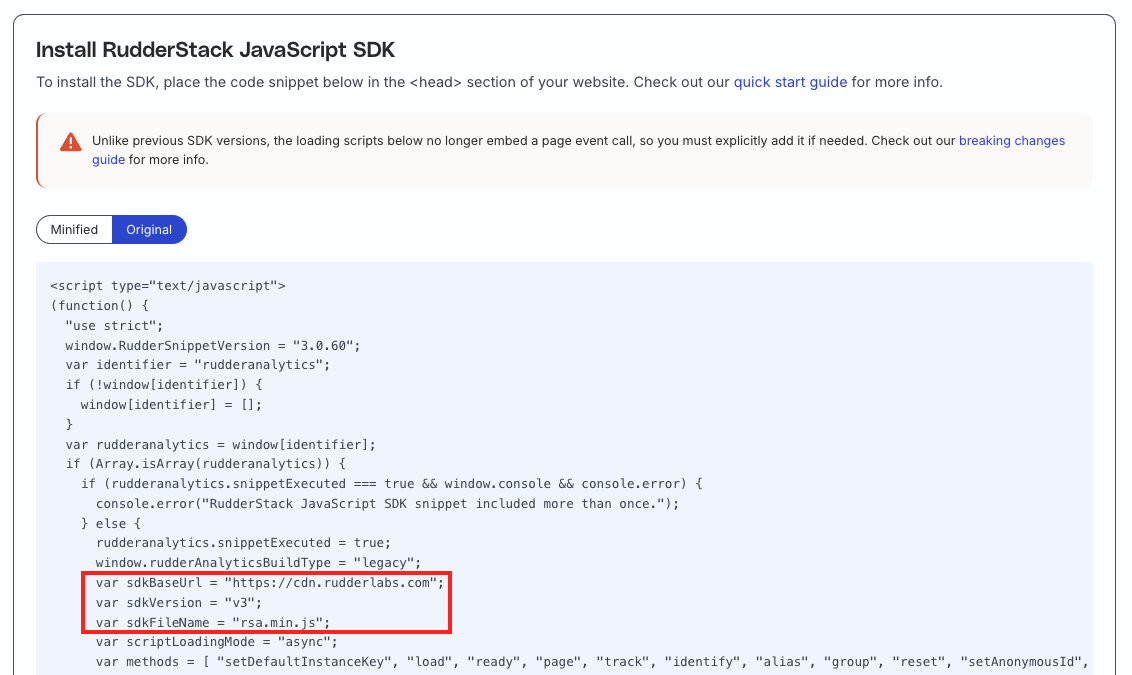
Example
- Base directory: rs-js-sdk-artifacts
- Subdirectory: custom-version-id (instead of the recommended v3)
- SDK file name:
customsdk.min.js
Then, update the SDK loading snippet as follows:
var sdkBaseUrl = "https://<subdomain>.<yourdomain>.com/rs-js-sdk-artifacts";
var sdkVersion = "custom-version-id";
var sdkFileName = "customsdk.min.js";
Then, the final URL would be:
https://<subdomain>.<yourdomain>.com/rs-js-sdk-artifacts/custom-version-id/customsdk.min.jsLoad device mode destinations and plugins
If you’ve installed the SDK via CDN and have retained the recommended directory and file structure, the SDK automatically determines the location of the device mode destinations and plugins.
Otherwise, provide location of the destination SDKs via the destSDKBaseURL load API option:
rudderanalytics.load(WRITE_KEY, DATA_PLANE_URL, {
  destSDKBaseURL: "https://<subdomain>.<yourdomain>.com/<integration-sdks-directory-path>"
});
Similarly, you can provide the location of the plugins via the pluginsSDKBaseURL load API option:
rudderanalytics.load(WRITE_KEY, DATA_PLANE_URL, {
  pluginsSDKBaseURL: "https://<subdomain>.<yourdomain>.com/<plugins-directory-path>"
});
Make sure to replaceWRITE_KEYandDATA_PLANE_URLwith their actual values.
