Vero Cloud Mode Integration
3 minute read
RudderStack lets you send your event data to Vero via cloud mode.
Find the open source transformer code for this destination in the GitHub repository.
Identify
The identify call lets you identify a user and associate them to their actions. It also lets you record any traits about them like their name, email, etc.
RudderStack sends the identify events to Vero via their users endpoint to create, update, and manage your user records and their subscription status.
A sample identify call is shown below:
rudderanalytics.identify("1hKOmRA4GRlm", {
  "email": "alex@example.com",
  "gender": "Male",
  "randomKey": "randomData"
})
Supported mappings
The following table lists the mapping of the RudderStack traits to the corresponding Vero properties:
| RudderStack trait | Vero property | Presence |
|---|---|---|
userId or anonymousId | id | Required. |
email | email | Optional |
traits | data | Optional |
context.os.name | channels.platform | Optional |
context.device.token | channels.address | Optional |
context.device.name | channels.device | Optional |
context.timezone | timezone | Optional |
context.locale | locale | Optional |
context.userAgent | userAgent | Optional |
IfuserIdis absent, RudderStack mapsanonymousIdto Vero’sidfield to create or update the user.
You can add or update user records as required as these are the custom properties.
Track
The track call lets you capture user events along with the properties associated with them.
RudderStack sends the track events to Vero via their events/track endpoint to track events for a specific user based on the actions they take. If a user profile does not exist, Vero will create one.
A sample track event is as shown:
rudderanalytics.track("Product Viewed", {
  SKU: "P001",
  "revenue": 77.6,
  "currency": "USD",
  "review_id": "R1619"
})
Vero does not differentiate between the upper or lower case letters, spaces, and underscores in the event names. For example, Vero matches thePurchased Item,purchased item, andpurchased_itemas the same event.
Supported mappings
The following table lists the mapping of the RudderStack properties to the corresponding Vero properties:
| RudderStack property | Vero property | Presence |
|---|---|---|
userId/anonymousId | identity.id | Required |
event | event_name | Required |
email | identity.email | Optional |
properties | data | Optional |
Unsubscribing and resubscribing users
RudderStack supports unsubscribing and resubscribing users in Vero by passing the userId in the track call:
rudderanalytics.track("unsubscribe", {
  userId: "1hKOmRA4el9Zt1WSfVJIVo4GRlm"
})
Page
The page call lets you record your website’s page views with any additional relevant information about the viewed page.
RudderStack sends the page events to Vero via their events/track endpoint.
A sample page call is shown below:
rudderanalytics.page(
  "Cart",
  "Cart Viewed", {
    path: "/best-seller/1",
    referrer: "https://www.google.com/search?q=estore+bestseller",
    search: "estore bestseller",
    title: "The best sellers offered by EStore",
    url: "https://www.estore.com/best-seller/1"
  }
);
Screen
The screen call lets you record whenever your user views their mobile screen, with any additional relevant information about the screen.
RudderStack sends the screen events to Vero via their events/track endpoint.
A sample screen call sent via the Android (Java) SDK is as shown:
MainApplication.rudderClient.screen(
    "Home Screen",
    RudderProperty().putValue("prop_key", "prop_value")
)
Alias
RudderStack sends the alias events to Vero via their users/reidentify endpoint to change a user’s identifier (id).
A sample alias call is shown below:
rudderanalytics.alias("userId", "previousId");Supported mappings
The following table lists the mapping of the RudderStack properties to the corresponding Vero properties:
| RudderStack property | Vero property | Presence |
|---|---|---|
userId | new_id | Required |
previousId | id | Required |
Adding and removing tags
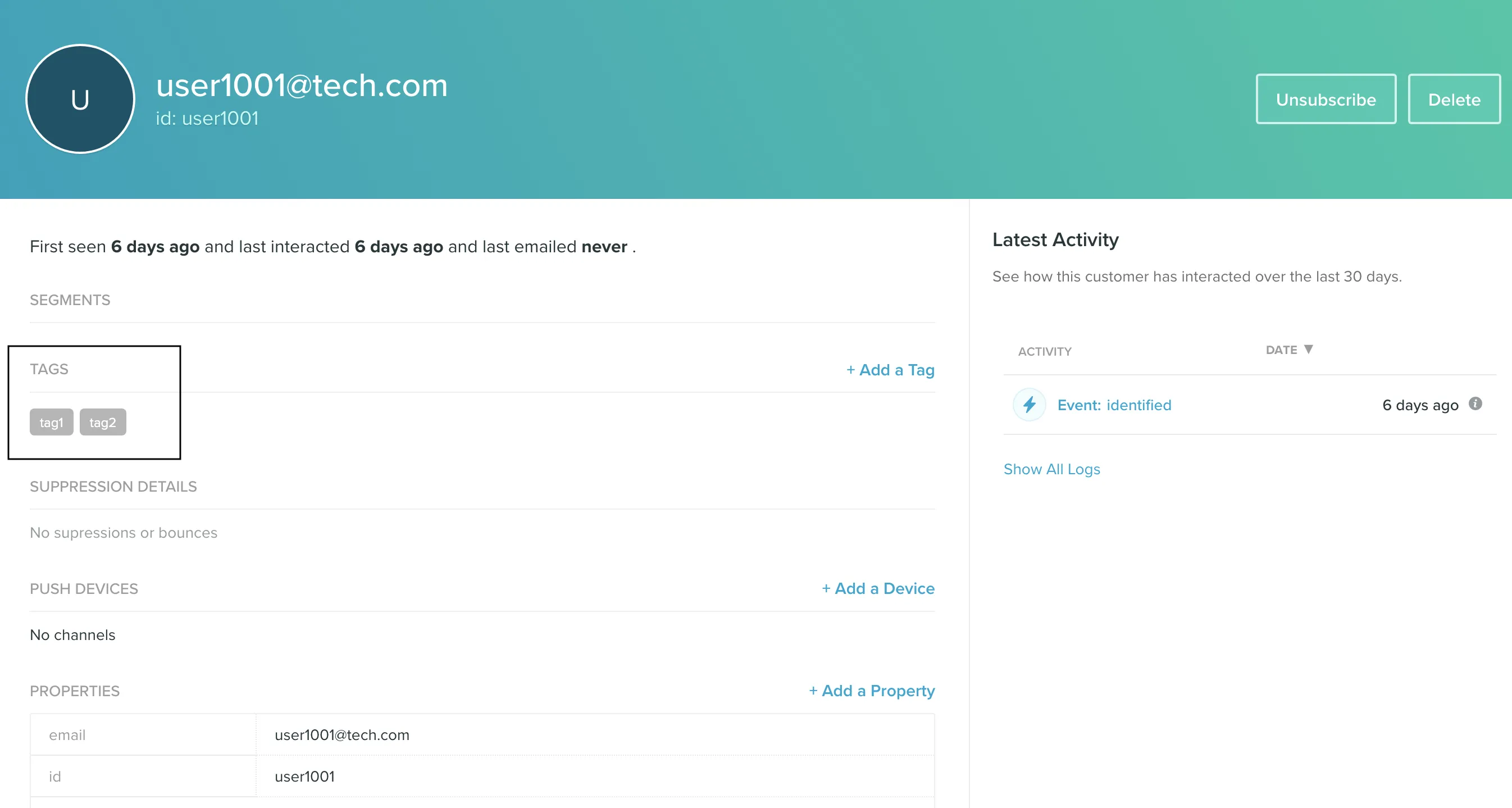
RudderStack supports adding and removing tags to all identify, track, page, and screen calls by passing them via the integrations object. An example snippet is shown below:
rudderanalytics.identify(
  "1hKOmRA4GRlm", {
    email: "alex@example.com"
  }, {
    integrations: {
      Vero: {
        tags: {
          add: ["tag1", "tag2"],
          remove: ["tag3"]
        }
      }
    }
  }
);
You can then view the updated tags associated with that user in the Vero dashboard: