Slack
8 minute read
Slack is a popular business communication platform that lets you organize all your business-related chats by specific topics, groups, or direct messaging.
Find the open source transformer code for this destination in the GitHub repository.
Connection compatibility
| Destination Information | |||
|---|---|---|---|
| |||


Get started
Once you have confirmed that the source platform supports sending events to Slack, follow these steps:
- From your RudderStack dashboard, add a source. Then, from the list of destinations, select Slack.
- Assign a name to the destination and click Continue.
Connection settings
To successfully configure Slack as a destination, you will need to configure the following settings:
Event channel settings
Use the following settings to send an event to a particular Slack channel:
| Setting | Description | ||||||
|---|---|---|---|---|---|---|---|
| Type of incoming webhooks | Select the API from the dropdown that RudderStack uses to send data to the particular Slack channel:
| ||||||
| Event Name | Enter the event name or regex to match the RudderStack event name. For example, the regex ^slack\.events\.[a-zA-Z_]+$ matches strings like:
| ||||||
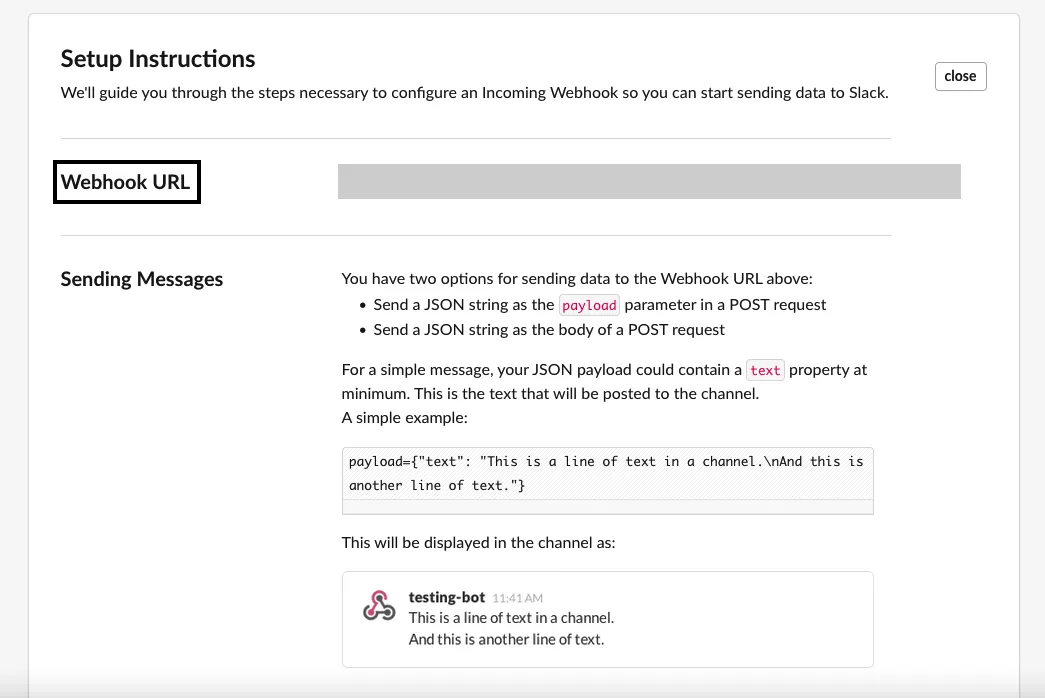
| Event Channel Webhook | Enter the webhook URL of the Slack channel where RudderStack sends the above event. This is a required field if you have set Type of incoming webhooks setting to Modern. Note: To get the URL for Event Channel Webhook setting, make sure to:
| ||||||
| Event Channel Name | Enter the Slack channel’s name where RudderStack should send the above event using the legacy method. You can specify #channel_name or @user_name.Note: If not specified, RudderStack sends the events to the Slack channel associated with the incoming webhook URL (see Webhook URL setting below). | ||||||
| Regex Matching | Turn on this setting if you are specifying a regular expression in the Event Name setting.
|
Identify template settings
| Setting | Description |
|---|---|
| Identify Template | Specify the template used to transform the identify event before sending it to Slack. RudderStack uses the following default template:Identified {{name}} <traits_key>:<traits_value> <traits_key2>:<traits_value2> ….Note: Here, the traits key and value are the key-value pairs in the traits object of the identify event payload. |
RudderStack determines the {{name}} field in the above template from either of the following:
traits.nametraits.firstName + traits.lastNametraits.usernameproperties.emailtraits.emailuserIdanonymousId
RudderStack considers only the traits listed in the Allowlisted Traits setting as a part of the identify template and ignores any other traits.
Event template settings
Use the following settings to transform an event before sending it to Slack:
| Setting | Description |
|---|---|
| Event Name | Enter the event name or regex to match the RudderStack event name. For example, the regex ^slack\.events\.[a-zA-Z_]+$ matches strings like:
|
| Event Template | Specify the template used to transform the above event. Note: RudderStack uses the following template by default and determines name similar to the Identify Template setting described above.{{name}} did {{event}} |
| Regex Matching | Turn on this setting if you are specifying a regular expression in the Event Name setting. |
RudderStack also provides a
{{newline}}helper for your Identify and Event templates to create multi-line Slack messages for better readability.See the Built-in helpers section for more information on using this helper.
Incoming webhook URL settings
RudderStack sends all the events to the channel associated with the incoming webhook URL by default.
| Setting | Description |
|---|---|
| Webhook URL | Enter your Slack’s incoming webhook URL. See the FAQ section for more information on obtaining this URL. |
Other settings
| Setting | Description |
|---|---|
| Allowlisted Traits | Specify the user traits you want to allowlist. Note: If not specified, RudderStack sends all the user traits to Slack. |
| Denylisted Events | Enter the events to add to your denylist, causing RudderStack to drop these events. |
| Consent management settings | Configure the consent management settings for the specified source by choosing the Consent management provider from the dropdown and entering the relevant consent category IDs. See Consent Management in RudderStack for more information on this feature. |
Handlebar expressions
RudderStack supports Handlebar expressions by leveraging the handlebars.js library for including the variables into your dynamic Slack messages.
Accessible Variables
The following table lists the variables you can select in your template messages:
| Handlebar expression | Output |
|---|---|
{{name}} | Identity name of the user in the priority order listed above. |
{{event}} | Event name, for example, Product Viewed or user login. |
{{key_1}}{{properties.key_1}} | The property values from the event’s properties object. |
{{propertiesList}} | JSON stringified version of your properties object. |
{{traits}} | JSON stringified version of your traits object. |
{{traitsList.key_1}} | The trait values from the event’s traits object. |
Built-in helpers
RudderStack also provides built-in Handlebars helpers to enhance your message formatting:
| Helper | Description |
|---|---|
{{newline}} | Inserts a line break in your Slack message. |
Some examples of using the Handlebars expressions with the {{newline}} helper after configuring the relevant dashboard settings are shown below:
- Handlebars expression
Identified {{name}}{{newline}}Email: {{traits.email}}{{newline}}Country: {{traits.country}}- CorrespondingSlack message
Identified Alex Keener
Email: alex@example.com
Country: USA- Handlebars expression
{{name}} completed purchase{{newline}}Order ID: {{properties.orderId}}- Corresponding Slack message
Alex Keener completed purchase
Order ID: 12345- Handlebars expression
New Order Alert!{{newline}}{{newline}}Customer: {{name}}{{newline}}Event: {{event}}{{newline}}Amount: ${{properties.revenue}}{{newline}}Items: {{properties.item_count}}- Corresponding Slack message
New Order Alert!

Customer: Alex Keener
Event: Order Completed
Amount: $100
Items: 2
Escaped content
The values returned by {{variable}} are HTML-escaped.
For example, if a variable has a & in its value, then it will be returned as &. To avoid this behavior, you can use the triple curly braces instead of double braces, like {{{variable}}} instead of {{variable}}—this will stop the handlebars from escaping a value if there is one. See the following example:
| Expression | Variable | Result |
|---|---|---|
{{variable}} | "Marcia & Jan" | "Marcia & Jan" |
{{{variable}}} | "Marcia & Jan" | "Marcia & Jan" |
Identify
The identify call lets you identify a visiting user and associate them to their actions. It also lets you record the traits about them like their name, email address, etc.
End-to-end example
The following is an end-to-end example of how a identify call translates to a Slack message depending on your dashboard settings:
If you set the Identify template as follows:
- Allowlisted traits:
email,city,country - Identify template:
Welcome {{name}}!{{newline}}Email: {{traits.email}}{{newline}}Plan: {{traits.plan}}{{newline}}Location: {{traits.city}}, {{traits.country}}Then, for the following identify call:
rudderanalytics.identify("1hKOmRA4GRlm", {
  name: "Alex Keener",
  email: "alex@example.com",
  plan: "Premium",  // This won't appear since it's not allowlisted
  city: "San Francisco",
  country: "USA",
  phone: "+1234567890"  // This won't appear since it's not allowlisted
});
You will see the following message in your configured Slack channel:
Welcome Alex Keener!
Email: alex@example.com
Location: San Francisco, USA
Track
The track call lets you record the user events, that is, the actions your users perform, along with any properties associated with these actions.
End-to-end example
The following is an end-to-end example of how a track call translates to a Slack message depending on your dashboard settings:
Suppose you configure the Event template settings as follows:
- Event name:
Product Purchased - Event template:
{{name}} just bought something!{{newline}}Product: {{properties.product_name}}{{newline}}Price: ${{properties.price}}{{newline}}Order ID: {{properties.order_id}}{{newline}}Quantity: {{properties.quantity}}- Allowlisted traits:
name,email,city,country(affects the{{name}}resolution and available traits)
Then, if you identify the user as follows:
rudderanalytics.identify("1hKOmRA4GRlm", {
  name: "Alex Keener",
  email: "alex@example.com",
  plan: "Premium",  // This won't appear since it's not allowlisted
  city: "San Francisco",
  country: "USA",
  phone: "+1234567890"  // This won't appear since it's not allowlisted
});
And then, you send a track call as follows:
rudderanalytics.track("Product Purchased", {
  product_name: "Wireless Headphones",
  price: 149.99,
  order_id: "ORD-2025-619",
  quantity: 1,
  category: "Electronics"  // This will be available as {{properties.category}}
});
You will see the following message in your configured Slack channel:
Alex Keener just bought something!
Product: Wireless Headphones
Price: $149.99
Order ID: ORD-2025-619
Quantity: 1
Category: Electronics
FAQ
How do I obtain the incoming webhook URL?
To obtain the webhook URL, follow the below steps:
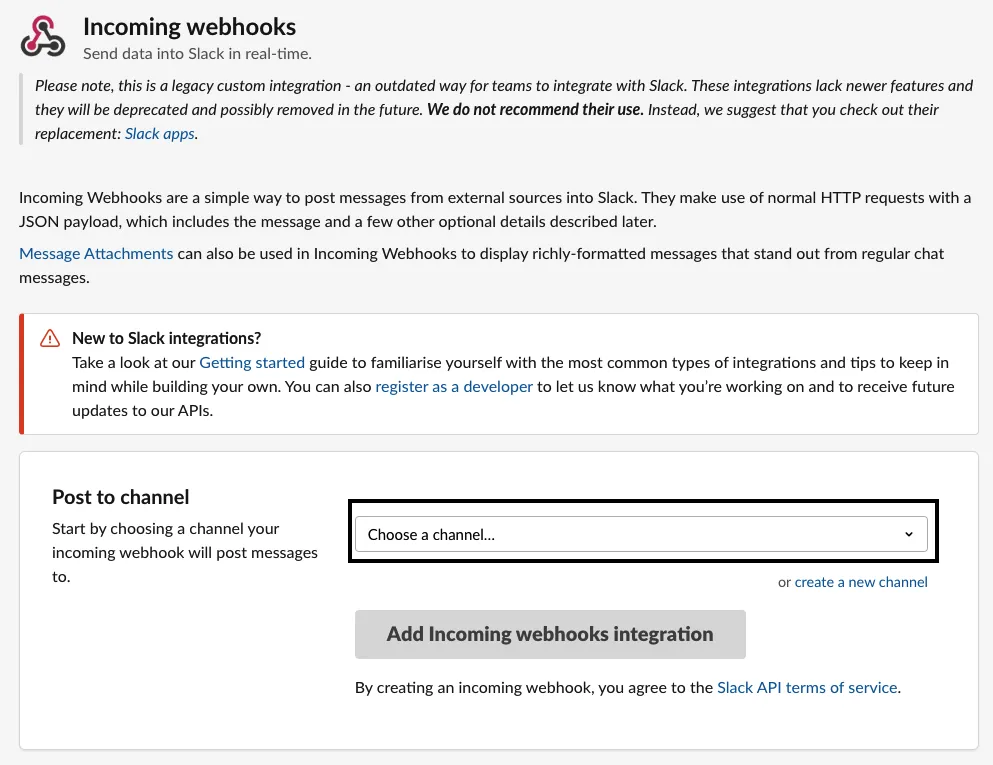
- Click your Slack workspace name, then go to Administration > Manage Apps.
- Search for Incoming webhooks in the Slack app directory and add it to Slack by clicking on Add to Slack.
- Select a channel where you want to post the messages forwarded by the webhook and click Add Incoming webhooks integration.
- Finally, copy the webhook URL and enter it in the RudderStack dashboard.
Why am I getting Slack messages for all the incoming events in one channel?
By default, RudderStack sends all the events to the Slack channel associated with the incoming webhook URL (Webhook URL setting in the RudderStack dashboard).
To get specific events in a particular channel, make sure you specify the mappings using the Event Name and Event Channel settings.
