Podsights (Spotify Ad Analytics)
8 minute read
Podsights has now been rebranded to Spotify Ad Analytics.
Podsights is a podcast advertising and attribution platform. It lets you plan your advertising campaigns and measure the effectiveness of your podcasts through audience insights and real-time impression reporting.
Connection compatibility
| Destination Information | |||
|---|---|---|---|
| |||


Get started
Once you have confirmed that the source platform supports sending events to Podsights, follow these steps:
- From your RudderStack dashboard, add the source. Then, from the list of destinations, select Podsights.
- Assign a name to your destination and click Continue.
Connection settings
To successfully configure Podsights as a destination, you will need to configure the following settings:
- Pixel ID: Enter your Podsights Pixel ID. For more information on obtaining your Podsights Pixel ID, refer to the FAQ section below.
- Map Rudder events to Podsights Pixel events: Use this setting to map your RudderStack events with standard Podsights Pixel events selected from the dropdown. You can map multiple Podsights Pixel events to a single RudderStack event and vice versa.
- Pass Internal ID: Enable this setting to pass a hashed internal ID in case of
aliasevents. For more information on obtaining the internal ID, refer to the FAQ section below. - Client-side Events Filtering: This setting lets you specify which events should be blocked or allowed to flow through to Podsights. For more information on this setting, refer to the Client-side Events Filtering guide.
- Use device mode to send events: As this is a web device mode-only destination, this setting is enabled by default and cannot be disabled.
- Consent management settings: Configure the consent management settings for the specified source by choosing the Consent management provider from the dropdown and entering the relevant consent category IDs. See Consent Management in RudderStack for more information on this feature.
Track
This destination does not strictly adhere to the RudderStack Ecommerce Event Spec.
You can use the Ecommerce Events Specification for sending the events while instrumenting your site with the RudderStack SDK.
You can use the RudderStack track event to track user events along with any associated properties and send this information to Podsights.
RudderStack supports the following standard Podsights Pixel events:
| Podsights Pixel event | Event name | Description |
|---|---|---|
| Lead | lead | User completed an action like form submission, free trial signup, button click, etc. |
| Product | product | User viewed a product. |
| Add to cart | addtocart | User added a product to cart. |
| Check out | checkout | User initiated a checkout. |
| Purchase | purchase | User purchased a product. |
You can map your RudderStack events to the above Podsights events in the RudderStack dashboard using the Map Rudder events to Podsights Pixel Events setting:
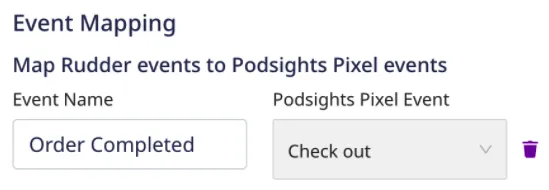
In the above example, RudderStack maps the event Order Completed with the Podsights checkout Pixel event.
By default, RudderStack maps the following events to the Podsights Pixel events:
| RudderStack event | Podsights Pixel event name |
|---|---|
Signed Up | lead |
Product Viewed | product |
Product Added | addtocart |
Checkout Started | checkout |
Order Completed | purchase |
RudderStack prioritizes the custom event mappings you set in the dashboard over the above standard mappings.
Lead
A sample track call mapped to a Podsights lead event is shown below:
rudderanalytics.track("Signed Up", {
  price: 500,
  currency: "USD",
  type: "paper",
  category: "Clothes"
});
The following table lists the mapping between the optional RudderStack event properties and the Podsight attributes:
| RudderStack property | Podsights property |
|---|---|
properties.price | value |
properties.currency | currency |
properties.type | type |
properties.category | category |
Product
A sample track call mapped to a Podsights product event is shown below:
rudderanalytics.track("product", {
  price: 1300,
  currency: "USD",
  product_id: "1234000",
  name: "goldenTest",
  product_type: "Card",
  brand: "testVendor"
});
The following table lists the mapping between the optional RudderStack event properties and the Podsight attributes:
| RudderStack property | Podsights property |
|---|---|
properties.price | value |
properties.currency | currency |
properties.product_id | product_id |
properties.name | product_name |
properties.product_type | product_type |
properties.brand | product_vendor |
Sending multiple product details
If you send the product details as an array in the track event, RudderStack fetches the details from each product item and calls the Podsights product event for each item. For example, consider the following track event:
rudderanalytics.track("Product", {
  price: 10.0,
  currency: "INR",
  quantity: 2,
  products: [
    {
      product_id: "S1100",
      name: "Product 1",
      product_type: "Card",
      brand: "Some Vendor"
    },
    {
      product_id: "S1200",
      name: "Product 2",
      product_type: "Card",
      brand: "Some Vendor 2"
    }
  ]
});
In this case, RudderStack makes two track calls to Podsights with the individual product details:
// Call 1

rudderanalytics.track("Product", {
  price: 10.0,
  quantity: 2,
  currency: "INR",
  product_id: "S1100",
  name: "Product 1",
  product_type: "Card",
  brand: "Some Vendor"
});

// Call 2

rudderanalytics.track("Product", {
  price: 10.0,
  quantity: 2,
  currency: "INR",
  product_id: "S1200",
  name: "Product 2",
  product_type: "Card",
  brand: "Some Vendor 2"
});
Add to Cart
A sample track call mapped to a Podsights addtocart event is shown below:
rudderanalytics.track("Add to Cart", {
  price: 23.2,
  currency: "USD",
  product_id: "1234000",
  name: "goldenTest",
  product_type: "Card",
  brand: "testVendor"
});
The following table lists the mapping between the optional RudderStack event properties and the Podsight attributes:
| RudderStack property | Podsights property |
|---|---|
properties.price | value |
properties.currency | currency |
properties.product_id | product_id |
properties.name | product_name |
properties.product_type | product_type |
properties.brand | product_vendor |
properties.quantity | quantity |
properties.variant_id | variant_id |
properties.variant_name | variant_name |
Similar to the Product event, if you send the product details as an array in the track event, RudderStack fetches the details from each product item and calls the Podsights addtocart event for each item.
Check out
A sample track call mapped to a Podsights checkout event is shown below:
rudderanalytics.track("checkout", {
  price: 30.0,
  currency: "USD",
  discount_code: "PODCAST_CODE_TEST",
  quantity: 3,
  line_items: [
    {
      price: 21.2,
      quantity: 1,
      product_id: "1234000",
      product_name: "goldenTest",
      product_type: "Card",
      product_vendor: "testVendor",
      variant_id: "11112",
      variant_name: "Test"
    }
  ]
});
The following table lists the mapping between the optional RudderStack event properties and the Podsight attributes:
| RudderStack property | Podsights property |
|---|---|
properties.price | value |
properties.currency | currency |
properties.quantity | quantity |
properties.variant_id | variant_id |
properties.discount_code | discount_code |
properties.line_items | line_items |
If you do not pass theline_itemsobject, then RudderStack fetches theline_itemsfrom the event’s properties and maps them to Podsight’sline_itemsfield.
Passing multiple product items
If you pass multiple product items as an array, then RudderStack fetches the individual product details and internally builds the line_items object before passing it on to Podsights via the checkout event, as demonstrated in the following example:
Consider the following track event:
rudderanalytics.track("Checkout", {
  price: 10.0,
  currency: "USD",
  quantity: 2,
  discountCode: "POD_CODE",
  products: [
    {
      price: 21.6,
      quantity: 12,
      product_id: "SKU123",
      name: "Card Game",
      product_type: "Card",
      brand: "Some Vendor",
      variant_id: "test123",
      variant_name: "Test 123"
    },
    {
      price: 42.4,
      quantity: 2,
      product_id: "SKU124",
      name: "Floppy Disk",
      product_type: "Card123",
      brand: "Some Vendor",
      variant_id: "test124",
      variant_name: "Test 124"
    }
  ]
});
RudderStack internally collates all product information and builds the line_items array before sending it to Podsights:
pdst("checkout", {
  price: 10.0,
  currency: "USD",
  discount_code: "POD_CODE",
  quantity: 2,
  line_items: [
    {
      price: 21.6,
      quantity: 12,
      product_id: "SKU123",
      product_name: "Card Game",
      product_type: "Card",
      product_vendor: "Some Vendor",
      variant_id: "test123",
      variant_name: "Test 123"
    },
    {
      price: 42.4,
      quantity: 2,
      product_id: "SKU124",
      product_name: "Floppy Disk",
      product_type: "Card123",
      product_vendor: "Some Vendor",
      variant_id: "test124",
      variant_name: "Test 124"
    }
  ]
});
Purchase
A sample track call mapped to a purchase event is shown below:
rudderanalytics.track("purchase", {
  price: 1000,
  currency: "rupee",
  discountCode: "PODCAST_CODE",
  orderId: "12322323232",
  is_new_customer: true,
  quantity: 3,
  line_items: [
    {
      price: 21.2,
      quantity: 1,
      product_id: "1234000",
      product_name: "goldenTest",
      product_type: "Card",
      product_vendor: "testVendor",
      variant_id: "11112222",
      variant_name: "testTest"
    }
  ]
});
The following table lists the mapping between the optional RudderStack event properties and the Podsight attributes:
| RudderStack property | Podsights property |
|---|---|
properties.price | value |
properties.currency | currency |
properties.discountCode | discount_code |
properties.line_items | line_items |
properties.orderId | order_id |
properties.is_new_customer | is_new_customer |
properties.quantity | quantity |
Similar to the Check out event, if you pass multiple product items as an array, then RudderStack fetches the individual product details and internally builds the line_items object before passing it on to Podsights via the purchase event.
Passing hashed internal ID to Podsights
If you turn on Pass Internal ID setting in the RudderStack dashboard and Alias events are enabled for your Podsight Pixel, then RudderStack triggers a Podsights alias event capturing the hashed internal user ID along with every conversion event.
Note that:
- The Podsights
aliasevent matches the Podsights internal cookie ID with your hashed internal user IDs.- RudderStack uses SHA-256 encryption for hashing your
userId.
To enable this feature, follow these steps:
- Activate Alias Events for your Podsights Pixel from your dashboard:
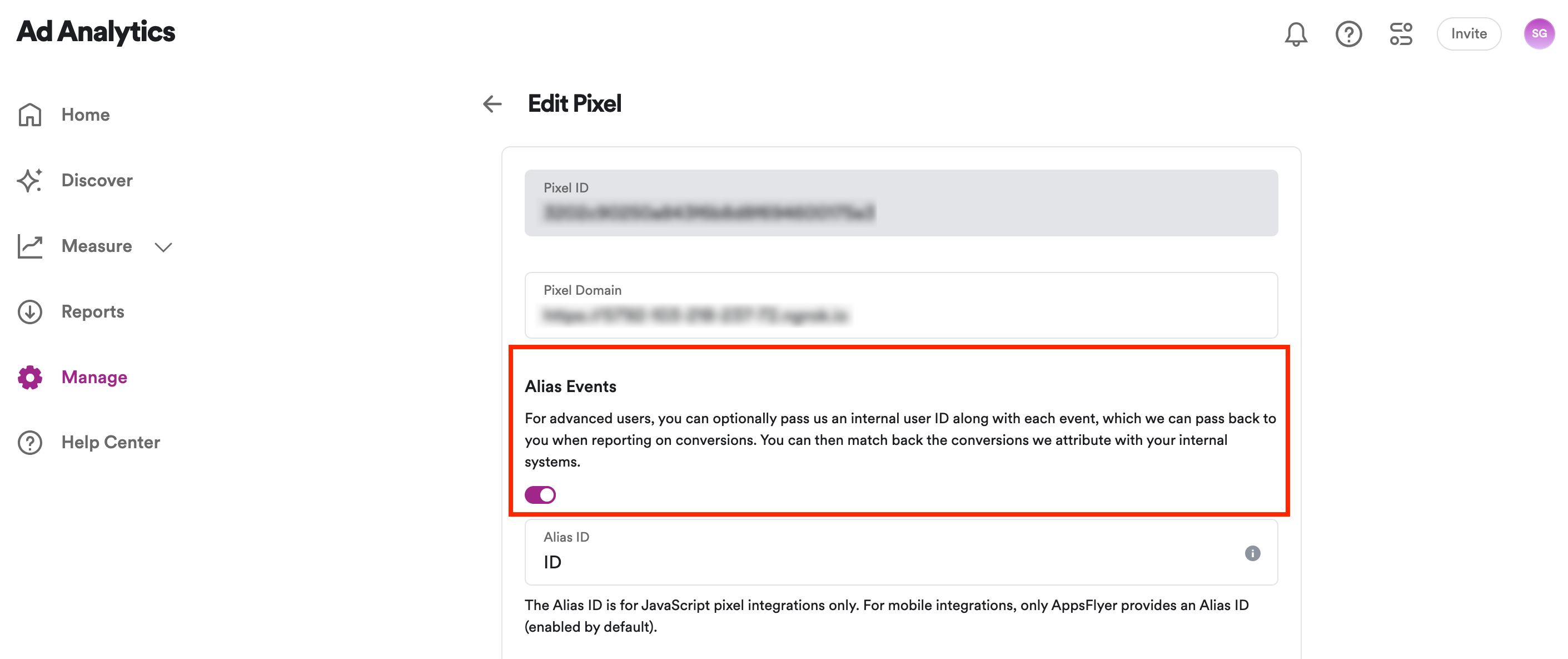
- Enable the Pass Internal ID setting in the RudderStack dashboard.
RudderStack automatically calls the Podsights alias event by mapping the following internal RudderStack IDs to Podsights:
| RudderStack attribute | Podsights attribute |
|---|---|
userIdcontext.traits.userIdcontext.traits.id | id |
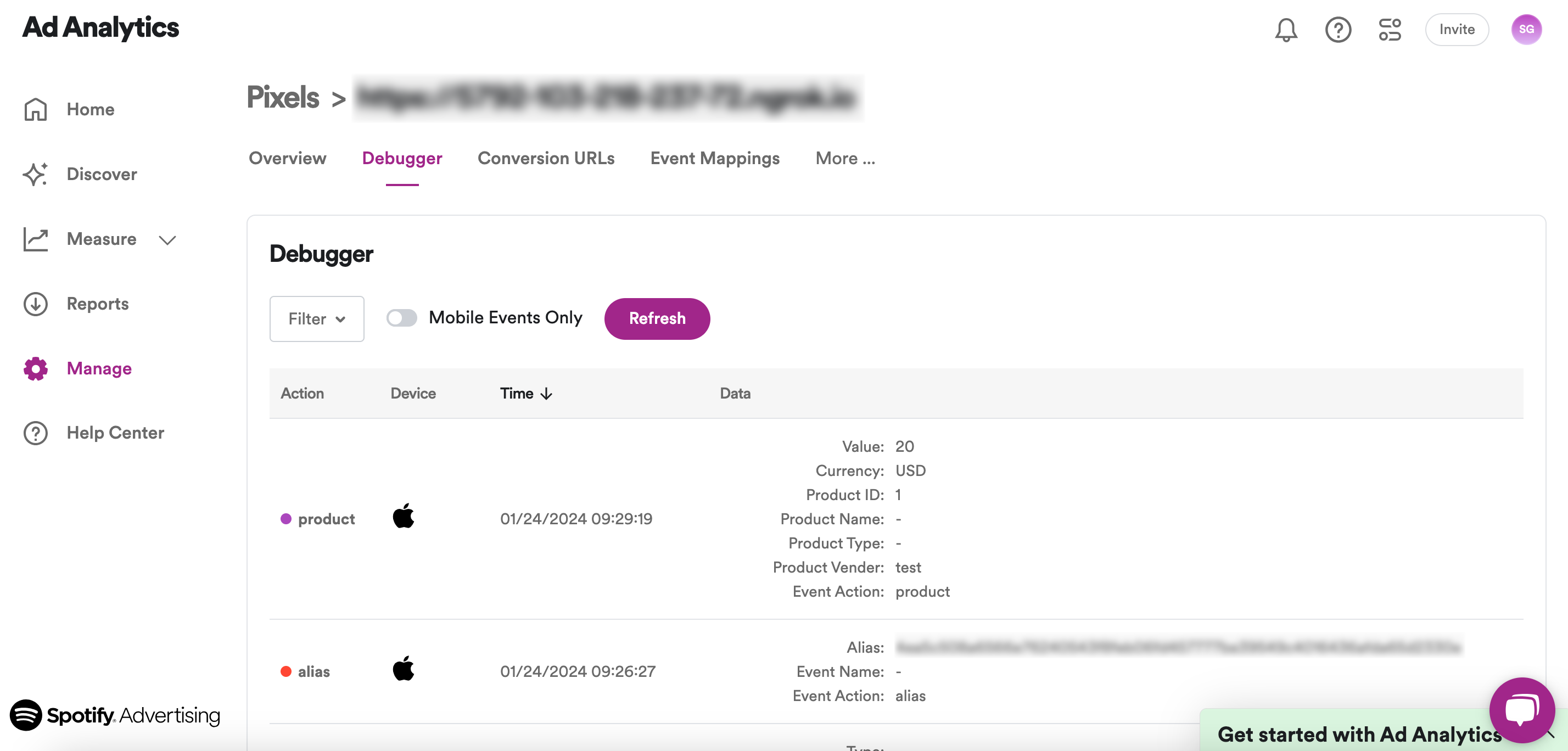
Suppose you send the following track call named testEvent mapped to Podsights’ lead event with the Pass Internal ID enabled:
rudderanalytics.track("testEvent", {
  price: 100,
  currency: "euro",
  type: "paper"
});
RudderStack then makes the following two calls to Podsights:
Page
You can use the page call to record your website’s page views with any additional information about the viewed page.
You can also set custom attributes inside thepageevent properties.
RudderStack sends the page calls to Podsights as a view event.
A sample page call is as shown:
rudderanalytics.page("Home", "Clothes", {
  path: "/best-seller/1",
  referrer: "https://www.google.com/search?q=estore+bestseller",
  url: "https://www.estore.com/best-seller/1"
});
Supported property mappings
RudderStack maps the following optional properties with the Podsights properties:
| RudderStack property | Podsights property |
|---|---|
context.page.referrer | referrer |
context.page.url | url |
FAQ
Where can I find the Podsights Pixel ID?
To get your Podsights Pixel ID, follow these steps:
- Log in to your Podsights dashboard.
- From the left sidebar, go to Manage > Your Pixels. You can find your Podsights Pixel ID under Your Pixels.
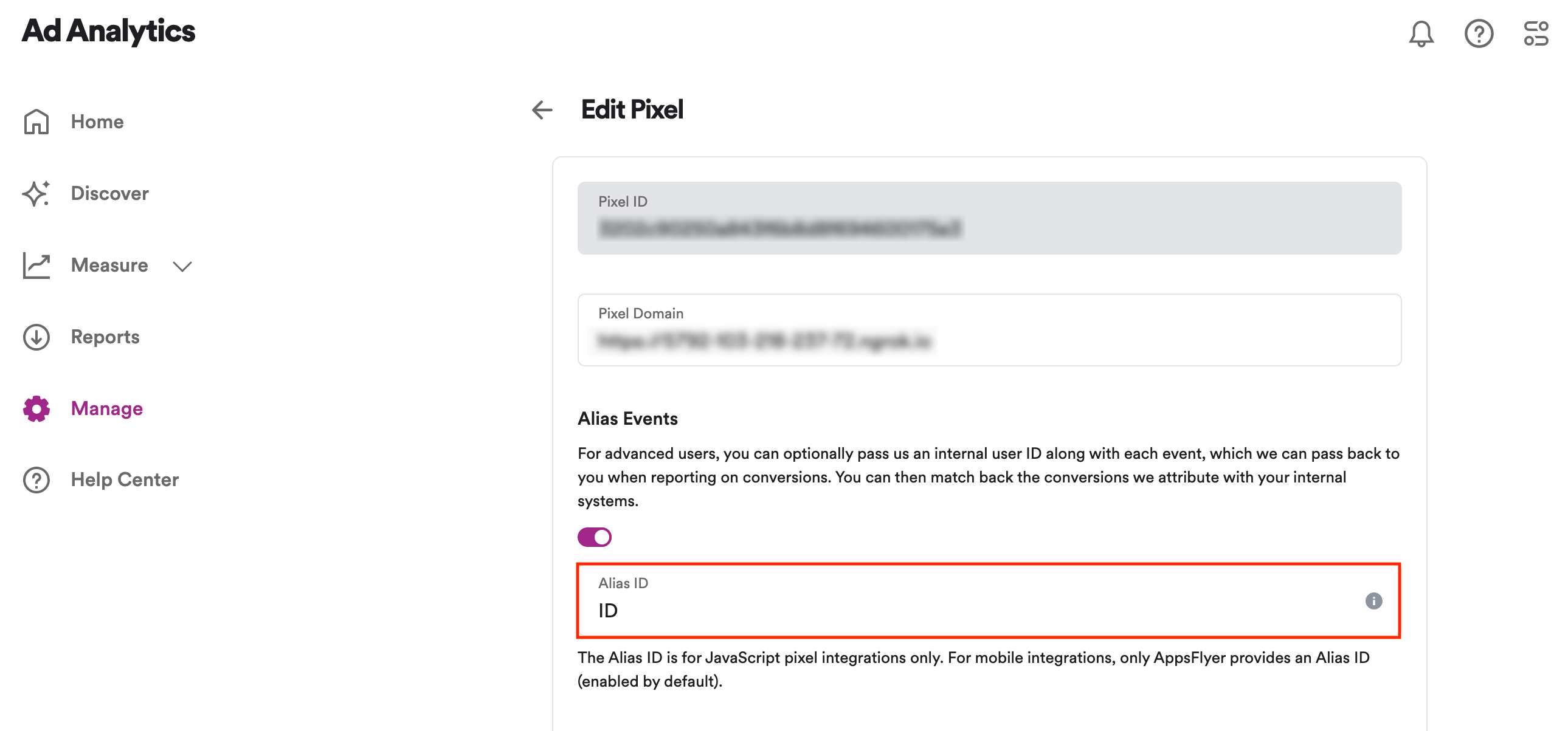
Where can I find the Podsights alias ID for alias events?
- Log in to your Podsights dashboard.
- From the left sidebar, go to Manage > Your Pixels. Then, click the edit button next to your pixel.
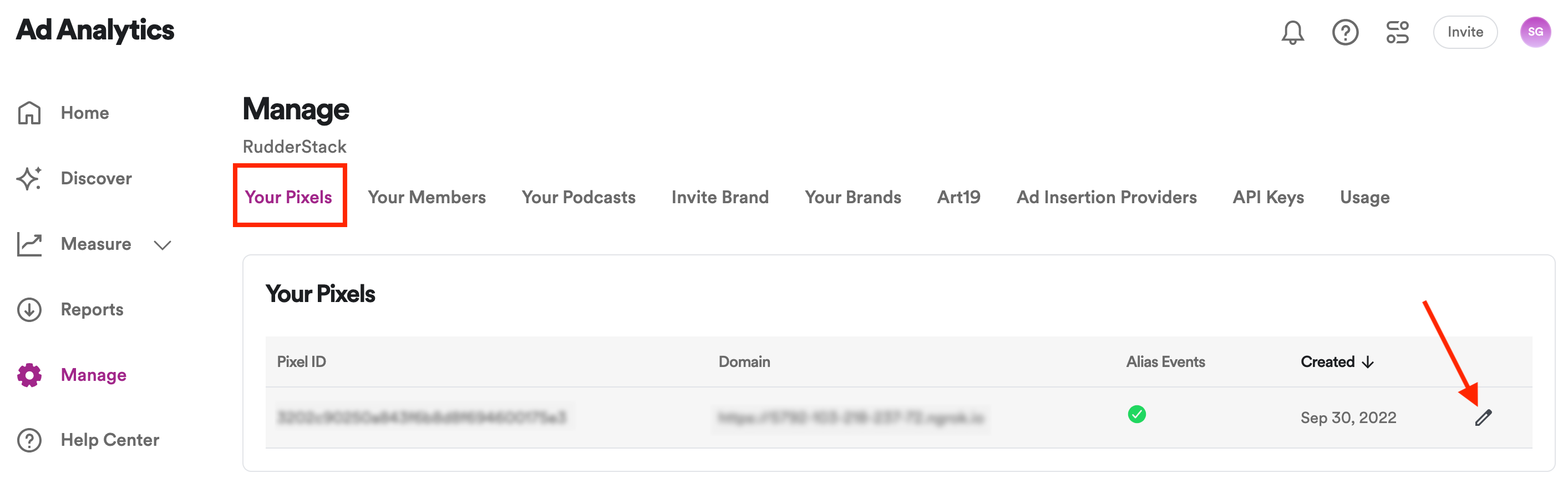
- The Alias ID is listed under Alias Events:
Where can I view the events sent to Podsights?
To view the events sent to Podsights, follow these steps:
- Log into your Podsights dashboard.
- From the left sidebar, go to Manage > Your Pixels.
- Click your pixel and go to the Debugger tab.
You can filter the events by name or platform, as per your requirement.
