Klaviyo Cloud Mode Integration (Old API) Deprecated
6 minute read
The Klaviyo API v2023-02-22 is deprecated.
RudderStack recommends using the New API integration instead.
After you have successfully instrumented Klaviyo as a destination in RudderStack, follow this guide to correctly send your events to Klaviyo in cloud mode using the old API (v2023-02-22).
Identify
The identify call lets you identify a visiting user and associate them to their actions. It also lets you record the traits about them like their name, email address, etc.
You can send any number of key-value pairs as user traits and RudderStack updates them as custom profile properties in Klaviyo.
To create a new user in Klaviyo, you must pass either the userId, email, or phone properties in the identify call. If a user already exists, RudderStack updates the user profile with the latest values.
A sample identify call is shown below:
rudderanalytics.identify("1hKOmRA4el9Z", {
  firstName: "Alex",
  lastName: "Keener",
  email: "alex@example.com",
  phone: "+12 345 678 900",
  title: "Owner",
  organization: "Company",
  city: "Tokyo",
  country: "JP",
  zip: "100-0001",
  Flagged: false,
  Residence: "Shibuya",
  properties: {
    listId: "XUepkK",
    subscribe: true,
    consent: "email",
    smsConsent: true,
  },
})
Note that specifying consent and smsConsent in the event properties overrides the respective settings specified in the RudderStack dashboard.
Add and subscribe user to list
You can add and subscribe a user to a Klaviyo list by specifying the List ID in the RudderStack dashboard and setting the subscribe option to true. Alternatively, you can add listId within the event properties - this will override the List ID specified in the dashboard for that particular event.
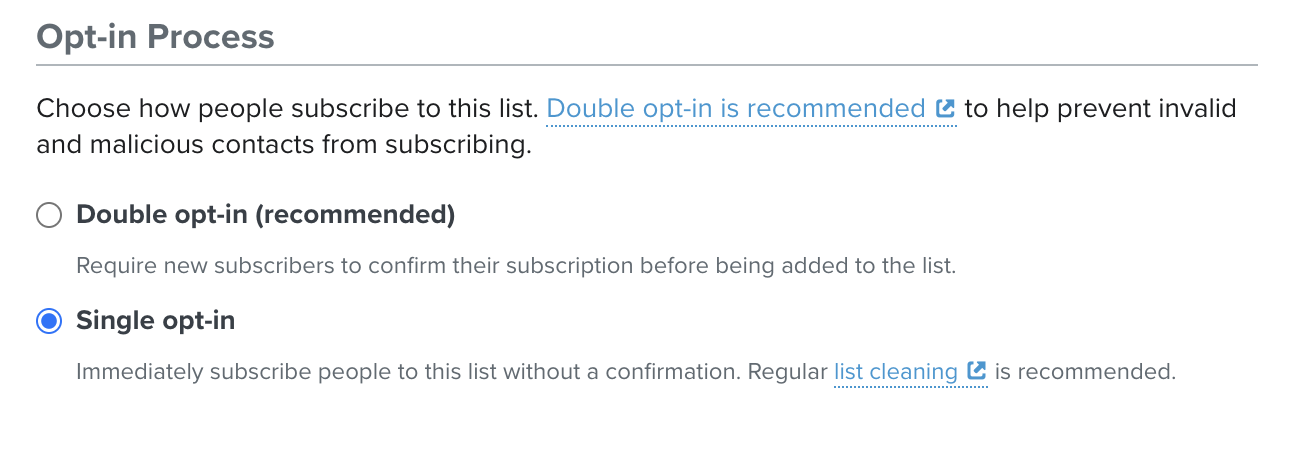
If you have enabled the Double opt-in setting for a list in Klaviyo, users will not be added to the list automatically without their consent. To add users to a list automatically without waiting for their consent, select the Single opt-in option in that list’s settings:
Track
This destination does not strictly adhere to the RudderStack Ecommerce Event Spec.
The track call lets you record the user actions along with any properties associated with them.
When sending events to Klaviyo in device mode, you must first identify your users before sending anytrackevents. Klaviyo does not record any anonymous user activity.
A sample track call is shown below:
rudderanalytics.track("Checked Out", {
  Clicked_Rush_delivery_Button: true,
  total_value: 2000,
  Ordered: ["T-Shirt", "jacket"],
  revenue: 2000,
})
In the above snippet, RudderStack captures the information related to the Checked Out event, along with the details of the event.
To associate a user with an event, you need to pass either their userId, email, or phone in the track call. A sample server-side track call along with the user information is as shown:
client.track({
  userId: "user2",
  event: "Item Purchased",
  properties: {
    revenue: 97.5,
    products: [
      {
        productId: "pro1",
        price: 32.5,
        quantity: 3,
      },
    ],
  },
  context: {
    traits: {
      email: "user2@gmail.com",
    },
  },
})
In the above snippet, RudderStack captures the information related to the Item Purchased event, along with its additional information in properties. Moreover, since this event is captured using a server-side SDK, RudderStack passes the user information in context along with a unique userId.
Note that:
- Use
context.traitsto pass the information in yourtrackorscreenevents in case you are using a server-side SDK that does not persist user context information. - To set a specific value to the
screenortracktype event, you need to pass the event-related property in thepropertiesfield. Also, you can sendrevenueproperty in thetrackevent and RudderStack automatically maps it to Klaviyo’s special property$value.
Ecommerce event mapping
RudderStack converts the following ecommerce events to the corresponding Klaviyo events:
| RudderStack event | Klaviyo event |
|---|---|
Product ViewedProduct Clicked | Viewed Product |
Product Added | Added to Cart |
Checkout Started | Started Checkout |
In addition to the above, RudderStack sends the following:
- Customer properties: Must contain either the
emailorphone_number(in E.164 format). RudderStack extracts these customer properties fromtraits/context.traitsin thetrackcall.
As mentioned above, you can send any number of key-value pairs as user traits and RudderStack updates them as custom profile properties in Klaviyo.
- Token: Public API key from the RudderStack dashboard.
Additionally, you can choose to send specific fields for each of the events covered in the following sections:
Product Viewed
RudderStack maps the Product Viewed event to Viewed Product and maps the following event properties:
| RudderStack property | Klaviyo property |
|---|---|
name | ProductName |
product_id | ProductID |
sku | SKU |
image_url | ImageURL |
url | URL |
brand | Brand |
price | Price |
compare_at_price | CompareAtPrice |
categories | Categories |
Product Added
RudderStack maps the Product Added event to Added to Cart and maps the following event properties:
| RudderStack property | Klaviyo property |
|---|---|
value | $value |
name | AddedItemProductName |
product_id | AddedItemProductID |
sku | AddedItemSKU |
image_url | AddedItemImageURL |
url | AddedItemURL |
price | AddedItemPrice |
quantity | AddedItemQuantity |
categories | AddedItemCategories |
item_names | ItemNames |
checkout_url | CheckoutURL |
items (deprecating soon)products | Items |
properties.itemswill be deprecated soon.
Note that products/items can contain the following parameters:
| RudderStack parameters | Klaviyo parameters |
|---|---|
product_id | ProductID |
sku | SKU |
name | ProductName |
quantity | Quantity |
price | Price |
total | RowTotal |
url | URL |
image_url | ImageURL |
categories | ProductCategories |
Checkout Started
RudderStack maps the Checkout Started event name to Started Checkout and maps the following event properties:
| RudderStack Parameters | Klaviyo Parameters |
|---|---|
order_id | $event_id |
value | $value |
categories | Categories |
item_names | ItemNames |
items (deprecating soon)products | Items |
checkout_url | CheckoutURL |
properties.itemswill be deprecated soon.
Note that products / items can contain the following parameters:
| RudderStack parameters | Klaviyo parameters |
|---|---|
product_id | ProductID |
sku | SKU |
name | ProductName |
quantity | Quantity |
price | Price |
total | RowTotal |
url | URL |
image_url | ImageURL |
categories | ProductCategories |
A sample track call containing the above ecommerce event parameters is shown below:
rudderanalytics.track("Checkout Started ", {
  order_id: "1234",
  value: 12.34,
  categories: ["category1", "category2"],
  checkout_url: "http://www.testcall.com",
  item_names: ["item1", "item2"],
  products: [{
      product_id: "pId1",
      sku: "sku1",
      name: "item1",
      url: "https://www.item1URL.com",
      price: 1.0,
      quantity: 1,
      image_url: "https://www.item1Image.com,
      categories: ["category1", "category2"],
      row_total: 1.0
    },
    {
      product_id: "pId2",
      sku: "sku2",
      name: "item2",
      url: "https://www.item2URL.com",
      price: 2.0,
      quantity: 1,
      image_url: "https://www.item2Image.com,
      categories: ["category1", "category2"],
      row_total: 2.0
    },
  ],
});
Screen
The screen method lets you record whenever a user sees their mobile screen along with any optional properties about the viewed screen.
A sample screen call is shown below:
[[RSClient sharedInstance] screen:@"Sample Screen Name" properties:@{@"prop_key" : @"prop_value"}];In Klaviyo, the above screen call is shown as Sample Screen Name along with the associated properties.
Group
The group call lets you associate a particular identified user with a group, such as a company, organization, or an account.
To make a group call successfully, you must include either email or phone in it. A sample server-side group call is shown:
client.group({
  userId: "userId",
  groupId: "listId",
  traits: {
    subscribe: true,
  },
  context: {
    traits: {
      email: "user.test@gmail.com",
      city: "city",
      country: "country",
      zip: "213456",
      age: 23,
      plan: "free",
      consent: "email",
      phone: "1-617-555-1333"
    },
  },
})
In the above snippet, the user with the associated traits is added and subscribed to the list as it is set to true.
Note that specifying consent in the event properties overrides the Consent setting specified in the RudderStack dashboard.
Troubleshooting
| Error | Reason | Solution |
| "detail": "Duplicate email found: alex@example.com." | The identifiers in the event are possibly from different user profiles in Klaviyo. | Make sure that all the identifiers in the event payload belong to the same user profile. To update a profile, you can provide the user's email, phone, or user ID. |
| "detail": "A profile already exists with one of these identifiers." |
