
Set up HubSpot Destination in RudderStack

Set up HubSpot as a destination in RudderStack.

This guide will help you set up HubSpot as a destination in RudderStack.

Connection compatibility

Destination Information
  • Status: Generally Available
  • Supported sources: Android (Java) , Android (Kotlin) , iOS (Obj-C) , iOS (Swift) , Web, Unity, AMP , Cloud, Warehouse, React Native , Flutter, Cordova, Shopify
  • Refer to it as HubSpot in the Integrations object.
Connection Modes
SourceCloud modeDevice modeHybrid mode
AMPsupportednot supportednot supported
Android (Java)supportednot supportednot supported
Android (Kotlin)supportednot supportednot supported
Cloudsupportednot supportednot supported
Cordovasupportednot supportednot supported
Fluttersupportednot supportednot supported
iOS (Obj-C)supportednot supportednot supported
iOS (Swift)supportednot supportednot supported
React Nativesupportednot supportednot supported
Shopifysupportednot supportednot supported
Unitysupportednot supportednot supported
Warehousesupportednot supportednot supported
Websupportedsupportednot supported
Supported Message Types
SourceIdentifyPageTrackScreenGroupAliasRecordAudienceList
Cloud mode
Supported sourcessupportednot supportedsupportednot supportednot supportednot supportednot supportednot supported
Device mode
Websupportedsupportedsupportednot supportednot supportednot supportednot supportednot supported
info

In the web device mode integration, that is, using JavaScript SDK as a source, RudderStack loads the HubSpot native SDK from the https://js.hs-scripts.com/ domain.

Based on your website’s content security policy, you might need to allowlist this domain to load the HubSpot SDK successfully.

Setup

  1. In your RudderStack dashboard, set up a source.
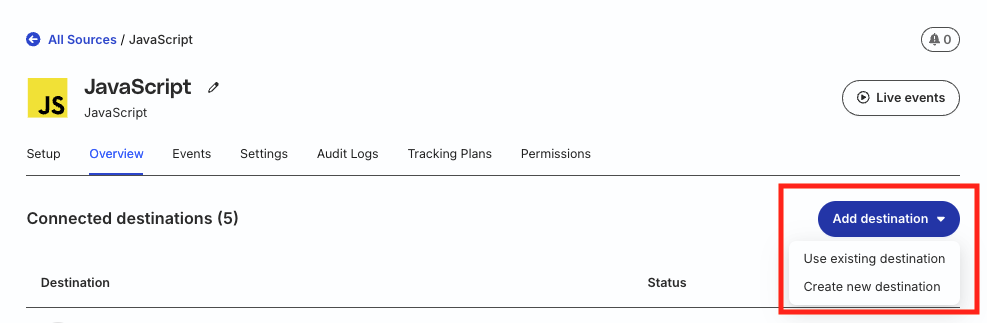
  2. Go to the Overview tab of your source and select Add Destination > Create new destination.
Add new destination in RudderStack dashboard
  1. Select HubSpot from the list of destinations. Then, click Continue.

Connection settings

Setting
Description
NameAssign a name to uniquely identify the destination in your RudderStack dashboard.
API VersionSelect the HubSpot API version from the dropdown. RudderStack supports both the New API (v3) and Legacy API (v1) (deprecated).
danger
HubSpot has deprecated the legacy API (v1). RudderStack recommends using the New API (v3) instead.

Legacy API settings

Setting
Description
Authorization TypeSelect the authorization mechanism from API Key (deprecated) or Private Apps.
API KeyIf you selected API Key, specify your HubSpot API key. You can find this by going to Settings > Integrations > API Key in your HubSpot account.

warning
HubSpot has deprecated the API key authentication mechanism.
Access TokenIf you selected Private Apps, specify the HubSpot access token.

New API settings

These settings are only applicable if you selected New API (v3) as the API version:

Setting
Description
Authorization TypeSelect the authorization mechanism from API Key (deprecated) or Private Apps.

  • If you select API Key, then specify your HubSpot API key by going to Settings > Integrations > API Key. Note that HubSpot has deprecated the API key authentication mechanism.
  • If you select Private Apps, then specify the HubSpot access token.
HubSpot property to be used for upsertEnter the contact property that RudderStack uses as a lookup field to match contacts in HubSpot, for example, uniqueId. Make sure to then pass the same property in the identify event’s traits object with the value to upsert.

For best performance, use a property that is unique in HubSpot — unique properties enable batch upsert and higher throughput, whereas non-unique properties use a slower search-based flow.

For more information, see HubSpot’s Create or update a batch of contacts API reference.

info
This setting is available only when using the new HubSpot API.

In the legacy API, RudderStack supports updating a contact only via email.

See the identify section for more information.
Create association between object recordsToggle on this setting to create associations between the object records while using a Reverse ETL source.

See Creating associations between object records section for more information.

Configuration settings

Setting
Description
Hub IDSpecify your HubSpot Hub ID.

See the HubSpot documentation for more information on obtaining this ID.
Setting
Description
Consent settingsConfigure the consent management settings for the specified sources by choosing the Consent management provider from the dropdown and entering the relevant consent category IDs.

See Consent Management in RudderStack for more information on this feature.

Web device mode settings

The below setting is applicable only if you want to send events to HubSpot in the web device mode:

Setting
Description
Client-side Events FilteringThis setting lets you specify which events should be blocked or allowed to flow through to HubSpot.

See Client-side Events Filtering for more information on this feature.

Event mapping settings

warning
These settings are applicable only for the New HubSpot API.

Click Set up mapping and map RudderStack events to your HubSpot custom behavioral events.

Although HubSpot provides some default properties with custom behavioral events, you can create additional custom properties and map them to specific RudderStack properties using these settings.

You can also specify multiple properties for a single event.

FAQ

Where can I find the HubSpot access token?

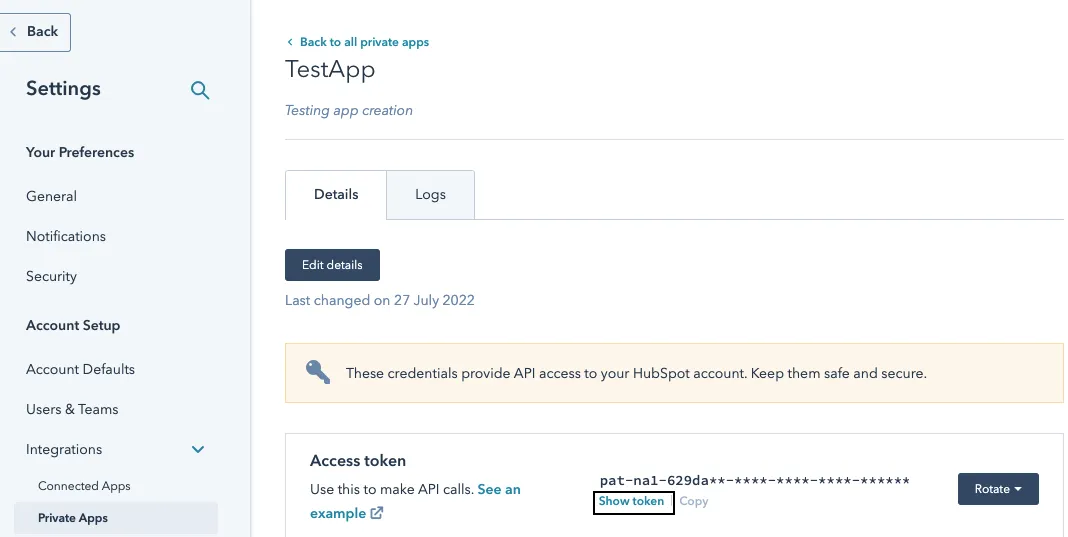
  1. Log in to your HubSpot account.
  2. Go to Integrations > Private Apps from the left sidebar.
  3. Click your app to get the access token:
warning

If you’re connecting a Reverse ETL source to HubSpot that uses private app access token for authentication, make sure your access token has the required scopes.

See the HubSpot documentation for more information on adding the above scopes.

Questions? We're here to help.

Join the RudderStack Slack community or email us for support