Setup Guide
5 minute read
This guide will help you set up FullStory as a destination in RudderStack.
Setup
- In your RudderStack dashboard, go to Directory > Destinations > Cloud Destinations and search for FullStory.
- Connect your source and click Continue.
Connection settings
Configure the following settings to set up FullStory as a destination in RudderStack:
- Name: Specify a unique name to identify the destination in RudderStack.
- API Key: Enter your FullStory API key required to send events to FullStory in cloud mode.
Make sure your API key has Admin or Architect permissions to view and delete data.
See FullStory documentation for more information on creating and managing your API keys.
- FS Org: Enter the
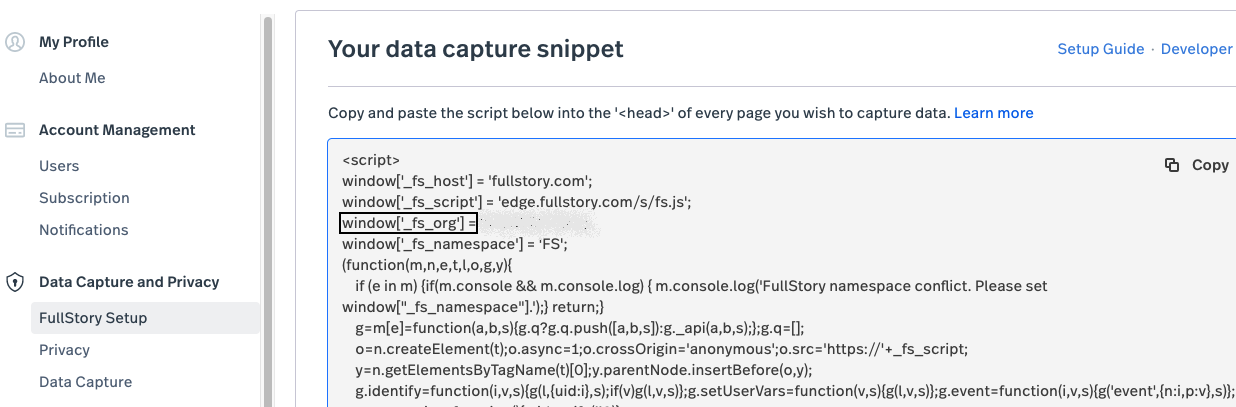
fs_orgvalue from your data capture snippet in your FullStory dashboard. For more information on getting this value, see FAQ.
This field is required for sending events to FullStory in web device mode.
Connection compatibility
| Destination Information | |||
|---|---|---|---|
| |||


In the web device mode integration, that is, using JavaScript SDK as a source, RudderStack loads the FullStory native SDK from the
https://edge.fullstory.comdomain.Based on your website’s content security policy, you might need to allowlist this domain to load the FullStory SDK successfully.
Configuration settings
After completing the initial setup, configure the following settings to correctly receive your data in FullStory:
- Client-side Events Filtering: This setting lets you specify which events should be blocked or allowed to flow through to FullStory. See Client-side Events Filtering for more information.
- Consent management settings: Configure the consent management settings for the specified source by choosing the Consent management provider from the dropdown and entering the relevant consent category IDs. See Consent Management in RudderStack for more information on this feature.
Web SDK settings
The following settings are applicable when sending events to FullStory in web device mode, that is, using their native web SDK:
- FullStory Host: If you have a custom FullStory host, enter the host name to initialize the FullStory SDK with it. The default value is
fullstory.com. - FS debug mode: This setting is enabled by default and lets you use the FullStory debugging feature.
Add mobile device mode integration
Once you add FullStory as a destination in the RudderStack dashboard, follow these steps to add it to your mobile project depending on your integration platform:
- Add the following dependencies in your
Podfile:
pod 'FullStory', :http => 'https://ios-releases.fullstory.com/fullstory-1.18.0-xcframework.tar.gz'
pod 'Rudder-FullStory', :git => 'https://github.com/rudderlabs/rudder-integration-fullstory-ios.git', :tag => 'v1.0.0'- Run the
pod installcommand. - Add the following imports to your
AppDelegate.mfile:
#import <Rudder/Rudder.h>
#import <RudderFullStoryFactory.h>- Initialize your iOS (Obj-C) SDK:
RSConfigBuilder *configBuilder = [[RSConfigBuilder alloc] init];
[configBuilder withDataPlaneUrl:dataPlaneUrl];
[configBuilder withFactory:[RudderFullStoryFactory instance]];
RSClient *rudderClient = [RSClient getInstance:writeKey config:[configBuilder build]];
To complete the FullStory integration, you need to specify which FullStory organization to record. Follow these steps:
- Open your app’s
Info.plist. - From the menu, choose Editor > Add Item. Set the key name to
FullStoryand type toDictionary. - Right-click the FullStory row and choose Add Row. Set the key name to
OrgIdand type toString. For the value, paste your assigned organization ID.
When configured correctly, the Info.plist entry should look as follows:

For more information, see FullStory iOS documentation.
- Open your
app/build.gradle(Module: app) file and add the following under thedependenciessection:
implementation 'com.rudderstack.android.sdk:core:1.0.22'
implementation 'com.rudderstack.android.integration:fullstory:1.0.0'
implementation 'com.google.code.gson:gson:2.8.6'
// FullStory
repositories {
  maven { url "https://maven.fullstory.com" }
}
implementation 'com.fullstory:instrumentation-full:1.18.0@aar'- Add the FullStory Maven plugin to your build script. To do so, add the following snippet into the
Gradle Scriptssection of your rootbuild.gradle:
buildscript {
  repositories {
    google()
    jcenter()
    maven { url "https://maven.fullstory.com" }
  }
  dependencies {
    classpath 'com.fullstory:gradle-plugin-local:PLUGIN_VERSION'
    // NOTE: Do not place your application dependencies here; they belong
    // in the individual module build.gradle files
  }
}

allprojects {
    repositories {
        google()
        mavenCentral()
    }
}- Replace
PLUGIN_VERSIONwith the correct version of the FullStory Android plugin. You can find the latest release notes here. - To apply the FullStory plugin, add the following snippet into your app-specific
build.gradle(if your Gradle file adds plugins via plugin ID):
plugins {
  id 'com.android.application'
  id 'fullstory'
}
fullstory {
  org 'YOUR_ORG_ID_HERE'
}- If your Gradle file applies plugins, use the following snippet instead:
apply plugin: 'com.android.application'
apply plugin: 'fullstory'
fullstory {
  org 'YOUR_ORG_ID_HERE' // Replace with your organization ID.
}- To apply FullStory to all variants, including those used at debug time, add the following line below
org:
org 'YOUR_ORG_ID_HERE'
enabledVariants 'all'- Add the following permissions, if not present already, to your
AndroidManifest.xml:
<uses-permission android:name="android.permission.INTERNET"/>
<uses-permission android:name="android.permission.ACCESS_NETWORK_STATE"/>- Initialize the Android (Java) SDKAndroid (Java) refers to the legacy RudderStack Android SDK. Note that it will be deprecated soon.
For new implementations, use the Android (Kotlin) SDK instead. in yourApplicationclass’onCreate()method as shown:
// initialize Rudder SDK
val rudderClient =
    RudderClient.getInstance(
        this,
        WRITE_KEY,
        RudderConfig.Builder()
            .withDataPlaneUrl(DATA_PLANE_URL)
            .withFactory(FullStoryIntegrationFactory.FACTORY)
            .build()
    )
For more information, see FullStory Android documentation.
FAQ
How do I obtain FS ORG value?
- Log in to your FullStory dashboard.
- Click your Profile > Settings.
- Click FullStory Setup to get your data capture snippet and copy the value present under
window['_fs_org']: