Facebook Conversions Destination Setup Guide
6 minute read
This guide will help you set up Facebook Conversions as a destination in RudderStack.
Setup
- In your RudderStack dashboard, go to Directory > Destinations > Cloud Destinations and search for Facebook Conversions.
- Connect your source and click Continue.
Connection settings
Configure the following settings to set up Facebook Conversions as a destination in RudderStack:
- Name: Assign a name to uniquely identify the destination.
- Dataset ID: Enter the dataset ID. If an existing pixel is linked to your dataset, your dataset ID will be the same as your Pixel ID.
- Business Access Token: Enter the business access token from your Facebook business account. This is required to send events in cloud mode. For more information on obtaining the business access token, see the FAQ.
Connection compatibility
| Destination Information | |||
|---|---|---|---|
| |||


Configuration settings
After completing the initial setup, configure the following settings to correctly receive your data in Facebook:
Event settings
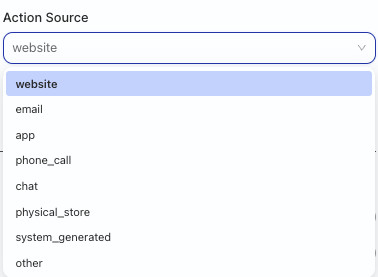
- Action Source: From the dropdown, select the fallback
action_sourcevalue you want to set ifaction_sourceis not present in your event properties. RudderStack provides the following options:
Destination settings
- Limited Data Usage: If turned on, RudderStack takes the data processing information from the payload and sends it to Facebook. The data in the RudderStack payload should be in the following format:
"context": {
  "dataProcessingOptions": [
    [
      "LDU"
    ],
    1,
    1000
  ],
  "fbc": "fb.1.1554763741205.AbCdEfGhIjKlMnOpQrStUvWxYz1234567890",
  "fbp": "fb.1.1554763741205.234567890",
  "fb_login_id": "fb_id",
  "lead_id": "lead_id",
  "device": {
    "id": "df16bffa-5c3d-4fbb-9bce-3bab098129a7R",
    "manufacturer": "Xiaomi",
    "model": "Redmi 6",
    "name": "xiaomi"
  },
  "network": {
    "carrier": "AirCarrier"
  },
  "os": {
    "name": "android",
    "version": "8.1.0"
  },
  "screen": {
    "height": "100",
    "density": 50
  },
  "traits": {
    "email": "john@example.com",
    "anonymousId": "c82cbdff-e5be-4009-ac78-cdeea09ab4b1"
  }
}
If this setting is turned on, RudderStack maps the values in thecontext.dataProcessingOptionsarray tocommonData.data_processing_options,commonData.data_processing_options_country, andcommonData.data_processing_options_statefields.
You can set the value of the fbc parameter using the context.fbc field as shown in the above payload.
If not set explicitly, RudderStack autogenerates it using the following values:
Fetches
fbclidfromcontext.page.url.Uses
originalTimestampas the creation time.Sets
subdomainIndexto1.Sets
versiontofb.Use as Test Destination: Turn on this setting if you are using this destination for testing purposes and enter the Test Event Code. You can find this code in your Facebook dashboard. When turned on, you can check your events in the Facebook dashboard in realtime.
RudderStack maps thecontext.dataProcessingOptionstodata_processing_optionsin Facebook according to the Facebook developer documentation.
- Don’t send external_id for user: If turned on, RudderStack does not send either
userIdoranonymousIdas theexternal_idto Facebook.
Other settings
- Client-side event filtering: Specify the events to be discarded or allowed to flow through. For more information, see Client-side Event Filtering.
- Consent management settings: Configure the consent management settings for the specified source by choosing the Consent management provider from the dropdown and entering the relevant consent category IDs. See Consent Management in RudderStack for more information on this feature.
Event mapping
Click the Set up mapping button to map your RudderStack events and properties to specific Facebook custom events.
RudderStack expects the
timestampandoriginalTimestampfields to be present at the root level of thetrackevent payload in the ISO 8601 format.When you connect a Reverse ETL source to this destination and map your warehouse columns using the JSON mapper, these fields get placed inside
properties. Hence, you need to use a transformation and move them to the root level so RudderStack can map them correctly.See the Cloud Mode Integration Guide for full details.
PII properties
The allowlist/denylist settings control only the standard Facebook PII fields listed below. They do not affect other mapped properties or top-level RudderStack identifiers like
userIdoranonymousId.To control whether RudderStack sends
userIdoranonymousIdasexternal_id, use the Don’t send external_id for user setting.
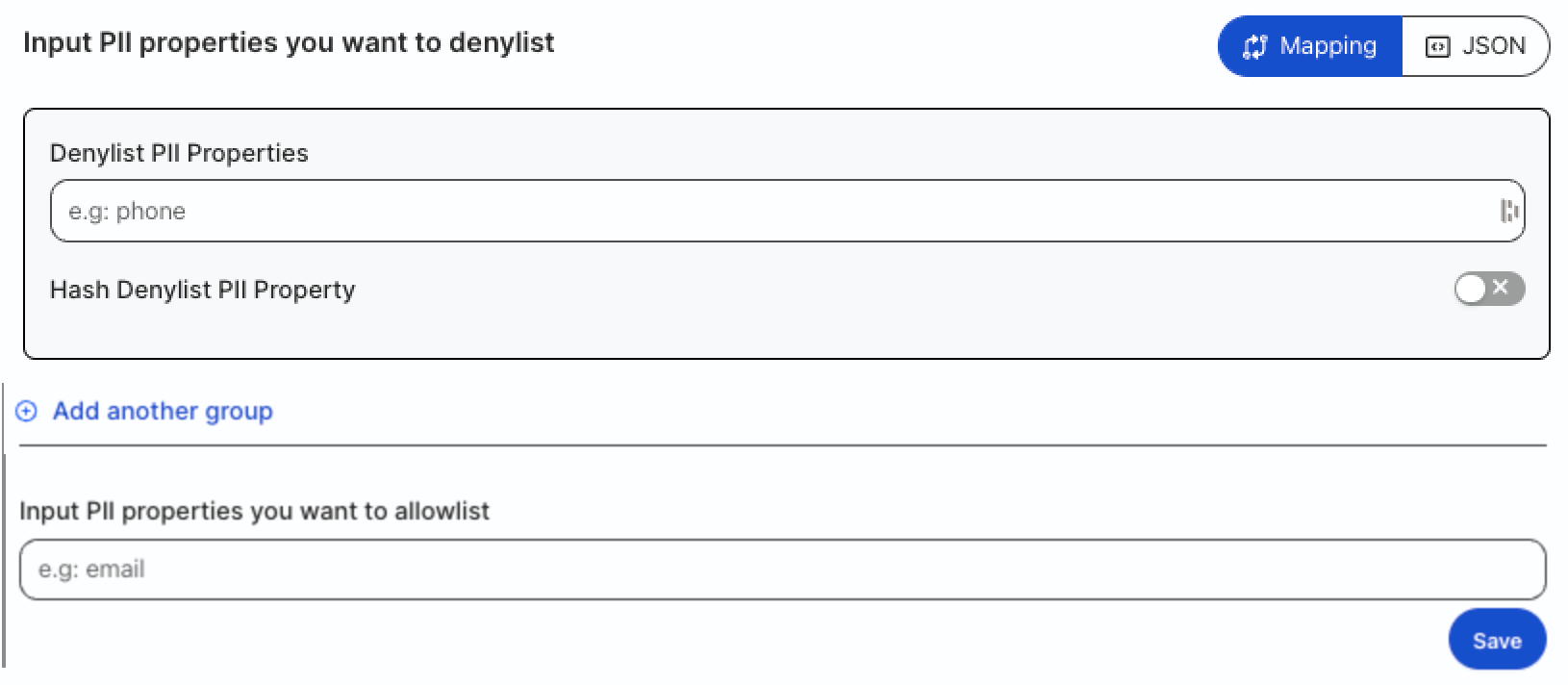
Denylist PII Properties: RudderStack drops the PII properties specified in this field. However, if you toggle on the Denylist PII Hash Property setting, RudderStack encrypts the properties in SHA256 format before sending them to Facebook. Facebook identifies the following standard fields as PII properties and they are denylisted by default:
emailfirstNamelastNamefirstnamelastnamefirst_namelast_namegendercitycountryphonestatezippostalCodebirthday
To hash and send any of the above properties instead of denylisting them, enter the property name in the Denylist PII Properties field and toggle on the Hash Denylist PII Property toggle.
- Allowlist PII Properties: The PII properties mentioned in this field are sent to Facebook if they are present in the event’s properties.
FAQ
Where can I find the dataset ID?
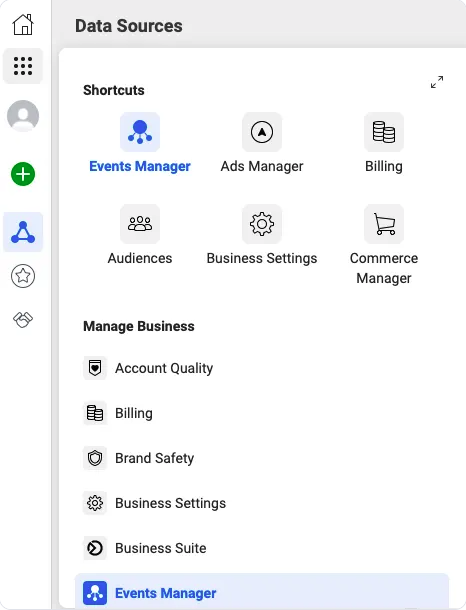
To get your dataset ID, go to your Facebook Ads Manager account. From the left navigation bar, select Business Tools, and click Events Manager under Manage Business.
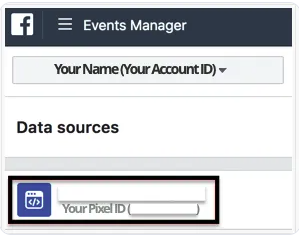
You should be able to see the ID underneath your site name under Data Sources:
Where can I find the Business Access Token?
In order to use the Facebook Conversions API, you need to generate an access token using the Facebook Events Manager:
- Choose the relevant Facebook Pixel and click the Settings tab.
- In the Conversions API section, click Generate access token under the Set up manually section:
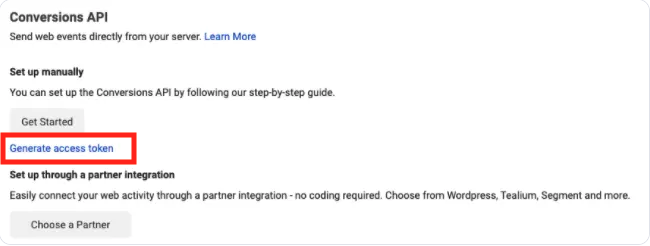
For more information on how to use this access token or to generate your access token via your own app, see the Facebook developer documentation.
Can I hash my event data before sending it to RudderStack?
Yes. Facebook requires all user data, including data coming from context.traits, to be hashed. This includes email, phone, birthday, address, etc. By default, RudderStack automatically hashes all of the necessary properties for you. However, to hash these traits before sending to RudderStack, you need to send your event as follows:
rudderanalytics.track(
  "event_name", {
    properties
  }, {
    integrations: {
      "Facebook Conversions": {
        hashed: true,
      },
    },
  }
)
RudderStack accepts any of the following names for Facebook Conversions in the
integrationsobject:
fb_conversionsfb conversionsFacebookConversionsFacebook ConversionsFB ConversionsFacebook_Conversions
The integrations object with these key-values notifies RudderStack to not hash the traits in context.traits as they are already hashed. Otherwise, RudderStack will hash your data again and Facebook will not be able to match the traits. Keep in mind that Facebook rejects any un-hashed data.
Why can I see my events in the RudderStack dashboard but not in the Facebook dashboard?
It may take up to 24 hours for your events to reflect in the Facebook dashboard.
You can also verify if your events are flowing correctly by toggling on the Use as Test Destination setting in the RudderStack dashboard - this reflects the events in the Facebook dashboard in real time.
