Airship
7 minute read
Airship is an app experience platform that lets you create and deliver powerful in-app experiences with the help of engaging, personalized content and actionable customer insights.
RudderStack supports Airship as a destination to which you can seamlessly send your event data.
Find the open source transformer code for this destination in the GitHub repository.
Connection compatibility
| Destination Information | |||
|---|---|---|---|
| |||


Get started
You must install the Airship SDK on your website/app to use this integration successfully. See the Airship documentation for more information on setting up the Airship SDK on your preferred platform.
Also, note that:
- Before sending events to Airship through RudderStack, make sure to first create the channel and named user in Airship via the Airship SDK.
- RudderStack supports enhancing the existing user profiles and sending custom events in cloud mode.
Setup
- In your RudderStack dashboard, add a source. Then, from the list of destinations, select Airship.
- Assign a name to your destination and click Next.
Connection settings
| Setting | Description |
|---|---|
| API Key | Enter your Airship token required by RudderStack to communicate with your Airship project and authenticate all supported event calls, that is, identify, track, and group. |
| App Key | Enter your Airship project’s app key which RudderStack requires for the track calls. You can obtain the app key by going to Settings > Project Details in your Airship dashboard. |
| Enter timestamp attributes | Specify the timestamp attributes to send to Airship in the Airship date time format. Note that the values for these attributes must be in UTC and should follow the ISO 8601 format. Note: RudderStack converts the attributes in the Airship format only if you specify them in this setting. |
| EU data center | Turn on this setting if you have implemented your app in Airship’s European data center. If you’re unsure which data center you are on, reach out to Airship support. |
| Consent management settings | Configure the consent management settings for the specified source by choosing the Consent management provider from the dropdown and entering the relevant consent category IDs. See Consent Management in RudderStack for more information on this feature. |
Identify
The identify call lets you uniquely identify a user and record any associated traits about them like their name, email, etc.
A sample identify call is shown below:
rudderanalytics.identify("1hKOmRA4el9Zt1WSfVJIVo4GRlm", {
  likes_movies: true,
  favorite_color: "purple",
  age: 13
});
In the above code snippet, RudderStack sends the Boolean values to Airship as tags, whereas the non-Boolean values are sent as attributes.
RudderStack maps some reserved traits to the predefined Airship attributes. See the Traits mapping section below for more information.
Tags
To successfully assign tags to Airship using the RudderStack identify events, you must create a tag group with the group key set to rudderstack_integration in Airship.
Note that this integration supports identify traits of Boolean data type only. Airship adds tags for the traits that are set to true and removes tags for the traits set to false.
Attributes
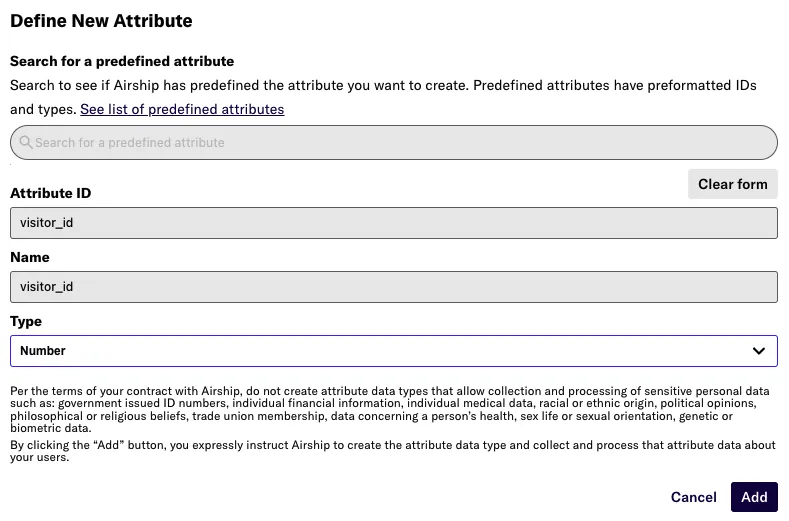
For identify traits that are not mapped to any predefined or custom-defined Airship attributes, you must create and enable those attributes in the Airship dashboard.
Track
The track call lets you capture user events along with the properties associated with them.
RudderStack sends the track events to Airship via their Custom Events API. You can use the event properties to personalize and trigger specific messages for your audience.
You need the Airship project’s App Key for authenticating thetrackcalls.
A sample track call is shown below:
rudderanalytics.track("Product Clicked", {
  description: "Shoes viewed",
  brand: "Sneakers",
  colors: ["red", "blue"],
  items: [
    {
      text: "New Balance Sneakers",
      price: "$69.95"
    },
    {
      text: "G.I. Joe Sneakers",
      price: "$99.95"
    }
  ]
});
In the above snippet, the event name Product Clicked is automatically converted to product_clicked before sending to Airship.
The event name sent to Airship must not contain any upper case characters. Otherwise, Airship rejects it with a
400status code.RudderStack handles this scenario internally by converting any upper case characters to lower case and replacing any spaces with an underscore(
_).
RudderStack also maps some event properties to the Airship properties before sending them over to Airship. See the Supported mappings section below for more information.
Group
The group call lets you link an identified user with a group such as a company, organization, or an account, and record any traits associated with that group, e.g., company name, number of employees, etc.
A sample group call is shown below:
rudderanalytics.group("5ea6247", {
  name: "Company Inc.",
  in_tecnology_domain: true,
  plan: "basic"
})
In the above code snippet, RudderStack sends the Boolean values to Airship as tags and the non-Boolean values as attributes.
To successfully assign tags to Airship using the RudderStackgroupevents, you must create a tag group with the group key set torudderstack_integration_groupin Airship. Similarly, you need to create the relevant attribute identifiers in Airship to set the attributes for the named users.
This integration supports group traits of type Boolean only. Airship adds tags for the traits that are set to true and removes tags for the traits set to false.
Supported mappings
RudderStack maps the following event properties to the Airship properties before sending them over to Airship.
See the Airship documentation for more information on how the externally-generated custom events are mapped.
| RudderStack property | Airship property |
|---|---|
userIdRequired | named_user_id |
eventRequired | name |
properties | properties |
value | value |
interactionId | interaction_id |
interactionType | interaction_type |
sessionId | session_idNote: RudderStack transforms this field based on the UUID v5 format using DNS as the reference namespace. |
transaction | transaction |
timestamp | occurred |
Traits mapping
| RudderStack trait | Airship attribute |
|---|---|
address.city | city |
address.country | country |
address.postalcode | zipcode |
address.state | region |
createdAt | account_creation |
firstName | first_name |
lastName | last_name |
name | full_name |
phone | mobile_phone |
Send user traits of array type
In case of the identify and group events, RudderStack supports sending user traits of string and integer types via the traits object, by default.
You can also send traits of array data type by including them in the event’s integrations object. For example, to send the below traits to Airship:
{
  ...
  "traits": {
    ...
    "widget_notifications": [
      "widget1_clicked",
      "widget2_viewed"
    ],
    ...
  }
}
Include them in the event’s integrations object within the JSONAttributes key in the <attribute_id>#<instance_id> format, as shown:
{
  ...
  "integrations": {
    "All": true,
    "Airship": {
      "JSONAttributes": {
          "widget_notifications#r0123": [
            "widget1_clicked",
            "widget2_viewed"
          ]
      }
    }
  },
}
RudderStack leverages Airship’s Attributes assignment API to send these attributes.
You can also remove any attributes by specifying them in the integrations object within the removeAttributes key, as shown:
{
  ...,
  "integrations": {
    "All": true,
    "Airship": {
      "removeAttributes": [
        "widget_notification1",
        "widget_notification2"
      ]
    }
  },
}
FAQ
Where can I find the Airship API key?
RudderStack requires the Airship API key to communicate with your Airship project. This is a mandatory field to set up the integration.
- In your Airship dashboard, go to Settings.
- In the Project configuration window, go to Tokens and click Manage.
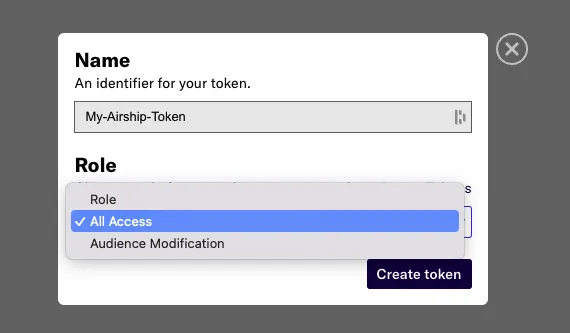
- Click Create token.
- Assign a name for your token. Under Role, select All access from the dropdown:
- Once the token is created, copy and secure the credentials and click Got it.
Where can I obtain the Airship App Key?
- In your Airship dashboard, go to Settings.
- In the Project configuration window, look for the Project Details pane on the right side. You will find your project’s app key listed here.
How do I create a custom tag group in Airship?
Go to Settings > Project configuration > Tag Groups and click Manage.
Click Create Tag Group and enter the following settings:
- Name: Enter the name for the tag group.
- Description: Set additional information about the tag group in this field.
- Group Key: Assign a unique ID for the tag group in this field. For example, to assign tags using the RudderStack
identifyevents, you can set this torudderstack-integration. For assigning tags using thegroupevents, set this torudderstack-integration-group.
See the Airship documentation for more information.
How do I create and enable attributes in Airship?
For identify traits that are not mapped to any predefined or custom-defined Airship attributes, you must create and enable those attributes in the Airship dashboard.
- Go to your Airship dashboard.
- Navigate to Audience > Attributes.
- Click Create Attribute.
- Enter the Attribute ID, Name, and select the attribute Type.
- Finally, click Add.