Connect Reverse ETL Source to X Audience Beta
4 minute read
This guide takes you through the steps to connect a Reverse ETL source to the X Audience destination.
Set up the connection
The Reverse ETL feature supports only source-driven pipeline configuration.
Make sure you have set up a RETL source and connected it to your X Audience destination before following the below steps.
Confirm the connection settings for X Audience destination and click Continue.
In the Where do you want to sync data to? section:
- Select Create New audience if you want to create a new data segment in X Audience. Specify the name and description of the data segment in the respective fields.
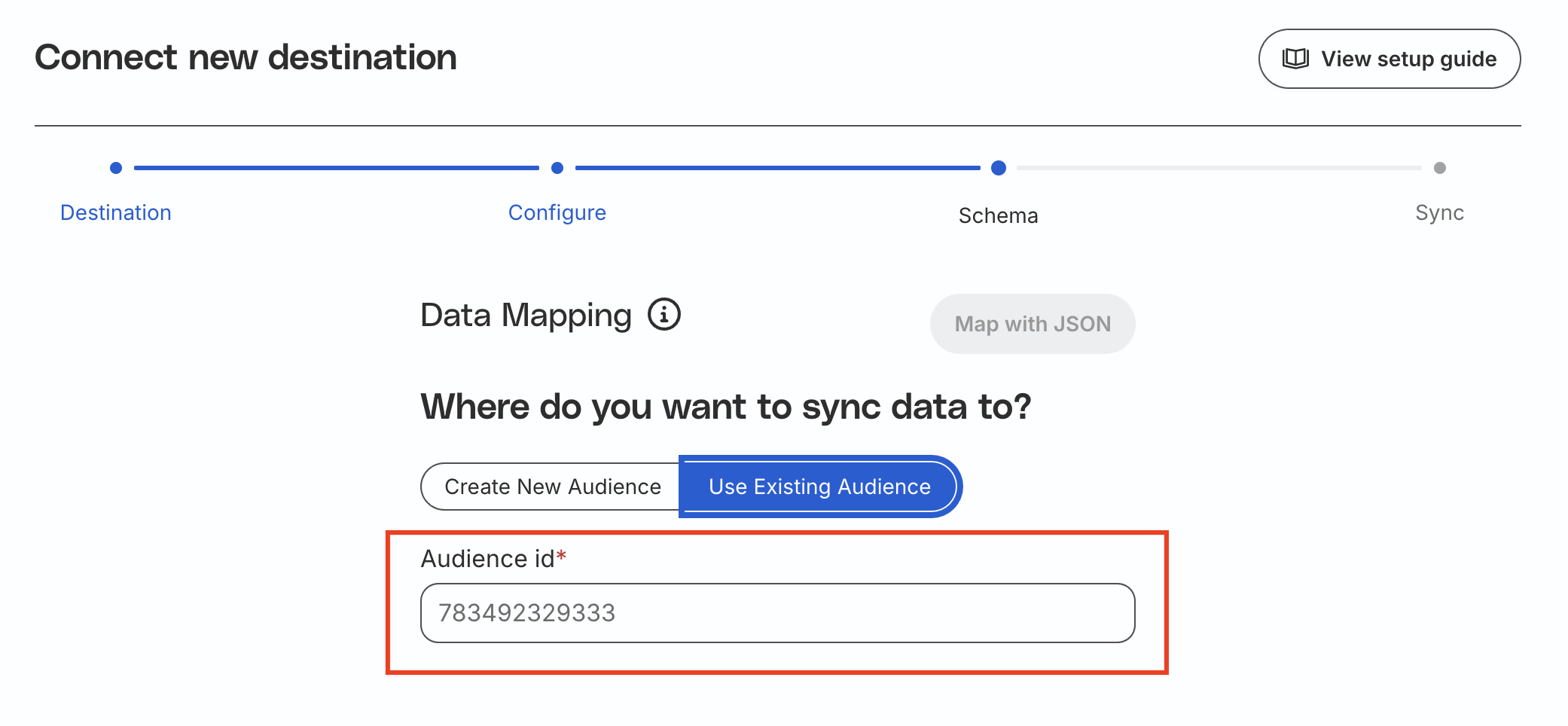
- Select Use Existing Audience if you have an existing audience segment in X Audience and specify the Audience ID.
Set the Sync mode to specify how RudderStack should sync the data to X Audience.
RudderStack currently supports syncing data to X Audience via mirror mode only.
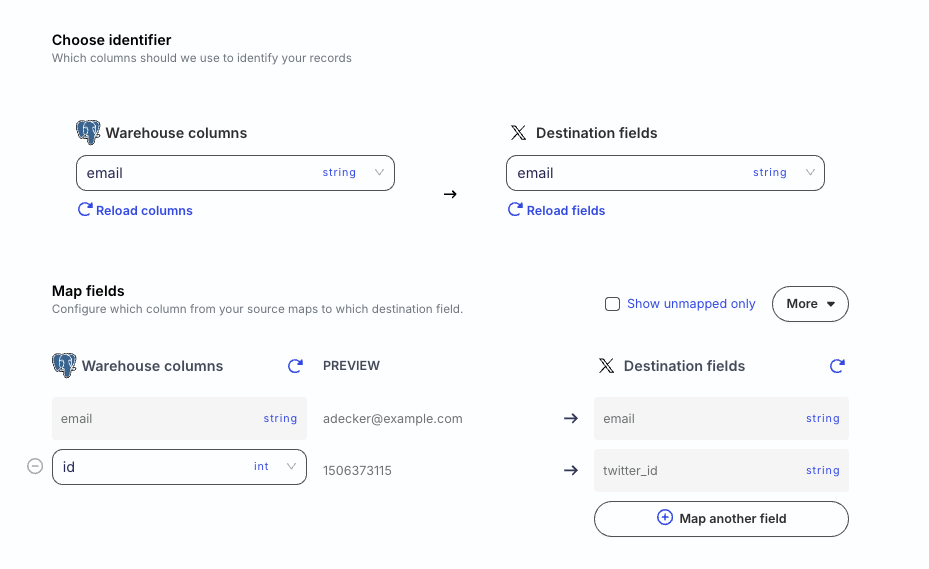
- In Choose identifier, specify the warehouse column that RudderStack uses to identify your records.
- Map your warehouse columns to specific X Audience fields using the Map fields setting.
Schedule settings
RudderStack determines how and when to run a sync based on the sync schedule you set for your Reverse ETL connection.
| Schedule type | Description |
|---|---|
| Basic | Run syncs at a given time interval and specified time (in UTC). |
| CRON | Run syncs based on a specified CRON expression (in UTC). |
| Manual | Run syncs manually. |
See Sync Schedule Settings guide for more information.
Sync settings
| Setting | Description | ||||||
|---|---|---|---|---|---|---|---|
| Retain sync logs | This setting is toggled on by default and instructs RudderStack to store the sync logs in your warehouse. You can also configure the below settings:
| ||||||
| Retry failed records | This setting is toggled on by default and causes RudderStack to continually retry sending the failed records. |
Storing sync logs and snapshot tables may incur additional warehouse costs.
See Sync Observability Settings guide for more information.
VDM mappings
RudderStack maps the below fields to the optional X Audience fields:
| RudderStack property | X Audience property | Comments |
|---|---|---|
email | email | String with comma-separated emails. |
phone_number | phone_number | String with comma-separated phone numbers. |
device_id | device_id | String with comma-separated device IDs (IDFA/AdID/Android ID of the user’s device). |
twitter_id | twitter_id | String with comma-separated Twitter IDs. |
partner_user_id | partner_user_id | String with comma-separated user IDs present in the partners’ system. |
handle | handle | String with comma-separated handles (@s) belonging to the user. |
effective_at | effective_at | UTC time (in string format) at which the custom audience association takes effect. It should be present in the ISO 8601 timestamp format. Note: By default, RudderStack sets it to the current date and time. |
expires_at | expires_at | UTC time (in string format) at which the custom audience association expires. It should be present in the ISO 8601 timestamp format. Note: The specified time must be later than the value of effective_at. By default, RudderStack sets it to 13 months from the request timestamp. |
| User parameters (see below) | users | List of objects. |
record event structure
RudderStack supports both updates and deletions to a user list sent to X.
The following code snippet shows a sample record event that RudderStack sends to X Audience:
POST https://ads-api.x.com/12/accounts/<account_id>/custom_audiences/1nmth/users
[
  {
    "operation_type": "Update",
    "params": {
      "effective_at": "2018-05-15T00:00:00Z",
      "expires_at": "2019-01-01T07:00:00Z",
      "users": [
        {
          "email": [
            "4798b8bbdcf6f2a52e527f46a3d7a7c9aefb541afda03af79c74809ecc6376f3"
          ],
          "handle": [
            "7352f353c460e74c7ae226952d04f8aa307b12329c5512ec8cb6f1a0f8f9b2cb",
            "49e0be2aeccfb51a8dee4c945c8a70a9ac500cf6f5cb08112575f74db9b1470d"
          ]
        },
        {
          "email": [
            "5bf13d5ad4200407c5bc8b9bb578e425d05ef936fd488e3799a9d0806669223c"
          ],
          "twitter_id": [
            "34d56c7159a7eea941f359653029410f813f65a1d2d13ecc5ccbdd5a8cb755cf",
            "00e7b76c9739dec57f4c4a20ec021a20ffcf26bd00f519b17ea00f0ed6048f85"
          ]
        }
      ]
    }
  },
  {
    "operation_type": "Delete",
    "params": {
      "effective_at": "2018-05-15T00:00:00Z",
      "expires_at": "2019-01-01T07:00:00Z",
      "users": [
        {
          "device_id": [
            "8d969eef6ecad3c29a3a629280e686cf0c3f5d5a86aff3ca12020c923adc6c92"
          ],
          "email": [
            "4798b8bbdcf6f2a52e527f46a3d7a7c9aefb541afda03af79c74809ecc6376f3"
          ],
          "handle": [
            "461222f5dd690a20651c3d19848015cb0369db3f8e937571ffb775de70750847"
          ],
          "twitter_id": [
            "c623c7e163984493b46c547088542e95d0aaa529bc52bbecce3ff91eb6b7843b"
          ]
        },
        {
          "email": [
            "5bf13d5ad4200407c5bc8b9bb578e425d05ef936fd488e3799a9d0806669223c"
          ],
          "twitter_id": [
            "858cdc7f313f84a3f3c48e9a6323307c1ef1bb7439b8e3623e140454b0fd8fa5",
            "bb074e154657b91d99bd1bb3757409149670e8ae7a0fe9136fae29a26a7881c8"
          ]
        }
      ]
    }
  }
]{
"request": {
"params": {
"account_id": "<account_id>",
"custom_audience_id": "1nmth"
}
},
"data": {
"success_count": 4,
"total_count": 4
}
}FAQ
Where can I find the X Audience ID?
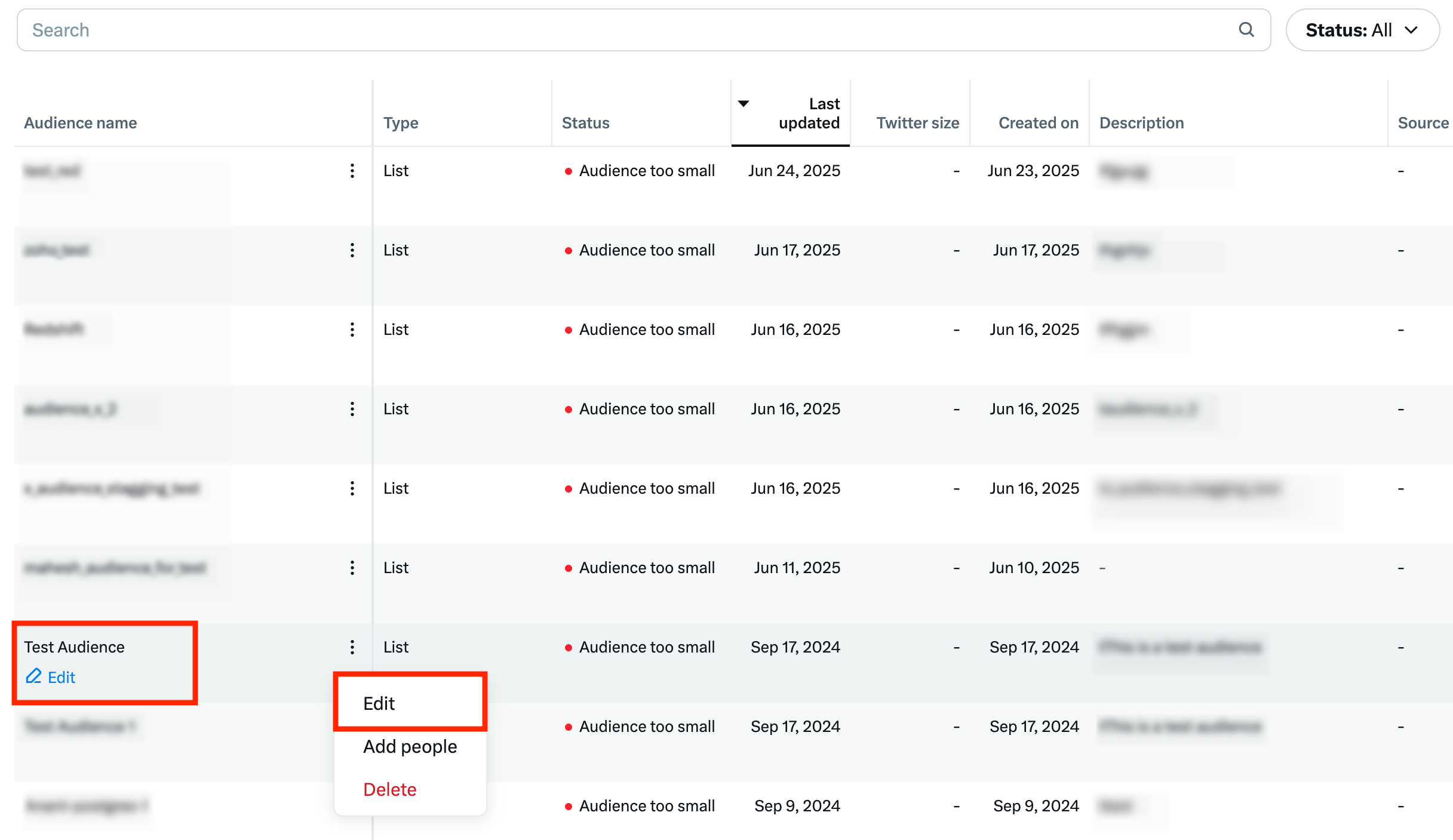
- In your X Audience Manager, go to Tools > Audiences.
- Click Edit next to the audience for which you want the Audience ID.
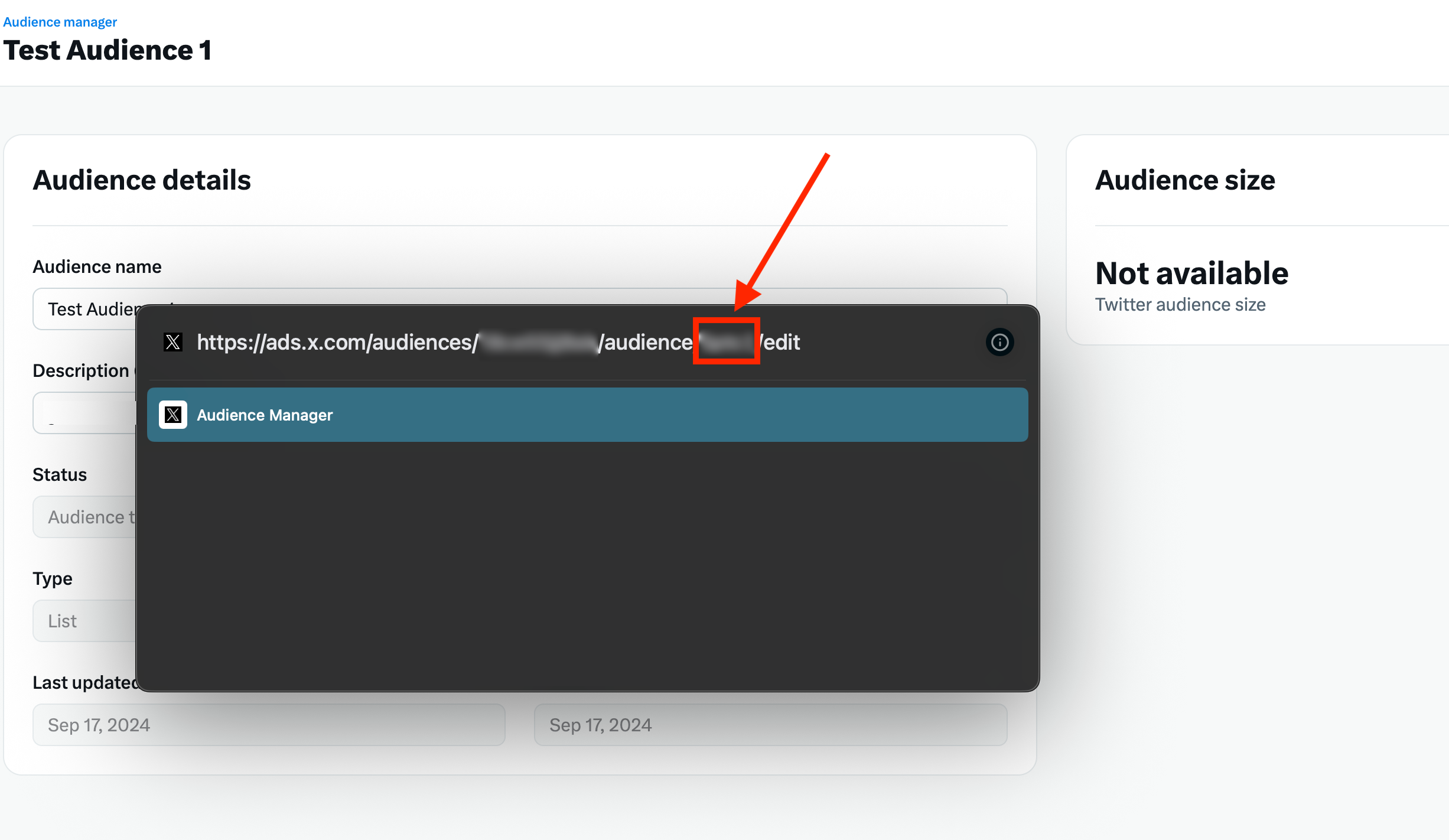
- Note the Audience ID displayed in the URL (
/audience/<AUDIENCE_ID>/edit)
Once you obtain the Audience ID, specify it in the Use Existing Audience setting under the Where do you want to sync data to? section of the X Audience destination configuration.
Why can’t I add a Reverse ETL source from the destination page?
The Reverse ETL feature supports only source-driven pipeline configuration. It means that you must configure a Reverse ETL source in RudderStack and then connect it to a new or existing destination. Note that this destination should not be connected to any other source.
See Reverse ETL FAQ for more information.
