Sync Observability Settings
4 minute read
This guide explains the settings to configure how RudderStack retains sync logs and snapshot tables for your Reverse ETL connection, and whether it retries failed records in later syncs.
Sync settings
Access these settings in the Settings tab of your Reverse ETL connection:
| Setting | Description | ||||||
|---|---|---|---|---|---|---|---|
| Retain sync logs | This setting is toggled on by default and instructs RudderStack to store the sync logs in your warehouse. You can also configure the below settings:
| ||||||
| Retry failed records | This setting is toggled on by default and causes RudderStack to continually retry sending the failed records. |
Storing sync logs and snapshot tables may incur additional warehouse costs.
Sync logs
RudderStack supports storing Reverse ETL sync logs in your warehouse. These logs are stored in a certain format in the RudderStack schema (used for storing the state of each sync). You can explore these logs using SQL or any BI tool to debug any issues or failures during syncs.
Storing the sync logs in your warehouse incurs additional costs.
Sync log table schema
The sync log table schema is as follows:
| Column | Description |
|---|---|
connection_id | Connection ID for the sync run. |
sync_run_id | Unique identifier for the sync run. |
primary_key | Value of the primary key column selected for the sync. |
operation | Nature of the operation performed on the row. It can be either insert, update, or delete. |
status | Result of the operation. It can be either succeeded or failed. |
error_reason | Reason for failure in case status is failed. |
sync_started_at | Sync start time in UTC. |
sync_finished_at | Sync finish time in UTC. |
Aborted syncs
When you stop a running sync, the sync stops and is treated as unsuccessful. In the dashboard, this appears as Aborted. In the sync log table, records from that run that did not succeed show status as failed.
The aborted sync does not resume — the next sync starts as a new run rather than picking up where the aborted one left off. Any records that did not sync successfully are handled in subsequent syncs according to your retry settings.
This differs from syncs interrupted by a system shutdown, for example during a deployment. In that case, the sync is paused safely and resumes from where it stopped once the system is back up.
Snapshot table schema
RudderStack generates a snapshot table in the RudderStack schema for each sync. It contains rows (barring invalid rows like duplicate primary keys and null primary keys) from the data source like a warehouse table, view, SQL model, or audience. It also includes the details of the changes that happened in each row during the sync.
Storing the snapshot tables in your warehouse will incur additional costs.
The snapshot tables are stored in the snapshot_<connection_id>_<sync_run_id> format, where:
<connection_id>is the Reverse ETL connection ID.<sync_run_id>is the unique identifier for the sync run.
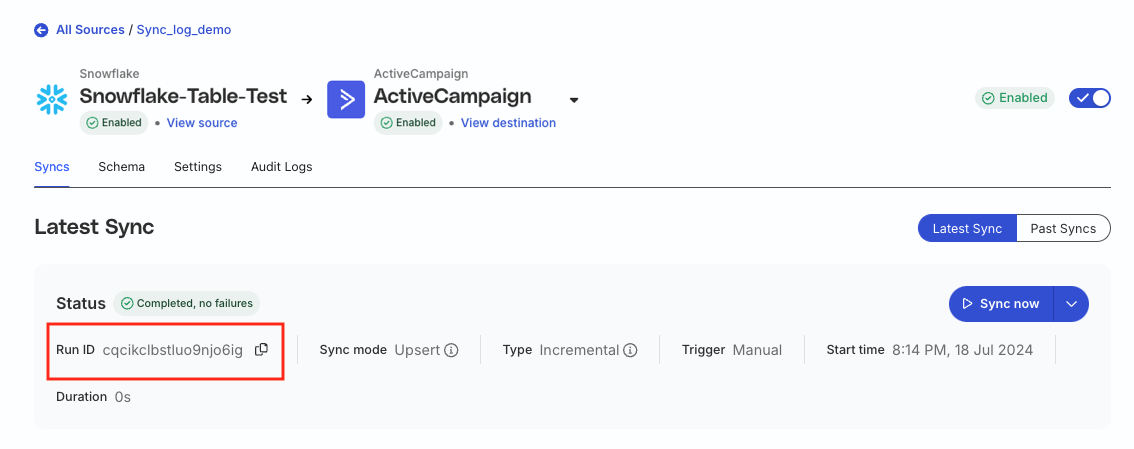
The snapshot table schema is as follows:
| Column | Description |
|---|---|
rudder_operation_type | Type of operation performed on the row when compared with the last synced data. It can be either insert, update, or delete. |
<column_name> | Name of the columns selected in the mappings for the sync. |
Debug issues with sync logs
This section lists some queries you can run on your sync logs for debugging issues in your Reverse ETL syncs.
- Check how a particular primary key has changed over time for a Reverse ETL connection:
select * from _rudderstack.sync_log where primary_key='<primary_key>' and connection_id='<connection_id>';- Check the data for failures in the sync run:
SELECT *
FROM   _rudderstack.sync_log sl
       LEFT JOIN
       _rudderstack.snapshot_<connection_id>_<sync_run_id>
       sn
              ON sl.primary_key = sn.<primary_key>
WHERE  sl.sync_run_id = '<sync_run_id>'
       AND sl.status = 'failed';
Make sure to replace the placeholders in the above queries with the actual values.
Retry failed records
The Retry failed records toggle in the sync settings lets you determine whether RudderStack should continually retry sending the failed records in the previous syncs to the downstream destination.
If a failed record has undergone any changes, RudderStack retries syncing the updated record instead.
