You are viewing documentation for an older version.

Define Cohorts in Profiles
Create core customer segments in your warehouse.
2 minute read
You can define cohorts along with any associated features and feature views in the profiles.yaml file.
yaml
models:
    - name: cohort_name
        model_type: entity_cohort
        model_spec:
            extends: cohort/path    # Optional
            materialization:        # Optional
                output_type: table\view
            filter_expression:        # Optional
              AND/OR:
                - filter_condition
            feature_views:          # Optional
                - id: column
name: feature_view_name| Key | Description |
|---|---|
nameRequired | Model name. |
model_typeRequired | Model type - set this parameter to entity_cohort. |
model_specRequired | Model configuration. |
extends | Path to the parent cohort. users/all is used for all members of an entity. |
output_type | Warehouse output, either table or view. |
filter_expression | Defines the filters. |
type | Filter type - accepted values are include or exclude. |
value | SQL statement of rows to filter (similar to a where clause). |
feature_view | Defines the id and name of any views. |
Example
yaml
# Basic cohort

models:
    - name: knownUsers
      model_type: entity_cohort
      model_spec:
          extends: user/all
          materialization:
             output_type: table
          filter_expression: "{{ user.id_type_email_count }} > 0"

# A cohort of a cohort

models:
    - name: knownUsersOrderWithCC
      model_type: entity_cohort
      model_spec:
          extends: models/knownUsers
          materialization:
              output_type: view
         filter_expression:
            AND:
              - "{{ knownUsers.has_credit_card }} = 1"
              - "{{ knownUsers.order_total }} > 0"

# Adding a feature view to a cohort

models:
    - name: knownUsers
      model_type: entity_cohort
      model_spec:
          extends: user/all
          materialization:
              output_type: table
          filter_expression: "{{ user.id_type_email_count }} > 1"
          feature_views:
            name: known_users_feature_view
              - id: email
                name: known_users_by_email

# Combining two cohorts into a new cohort

models:
  - name: americanUsers
    model_type: entity_cohort
    model_spec:
       extends: user/all
       filter_expression:
        OR:
          - "{{ warehouse.EntityCohortCondition('models/north_american_users', 'in') }}"
          - "{{ warehouse.EntityCohortCondition('models/south_american_users', 'in') }}"

# Create var_group for a cohort

var_groups:
    - name: known_users_vars
      entity_cohort: models/knownUsers
      vars:
          - entity_var:
            name: last_transaction
            select: max(order_date)
            from: inputs/orders
View cohorts in RudderStack dashboard
You can view the output for cohorts in the Entities tab of the UI once you import a Profiles project from Git and run it.
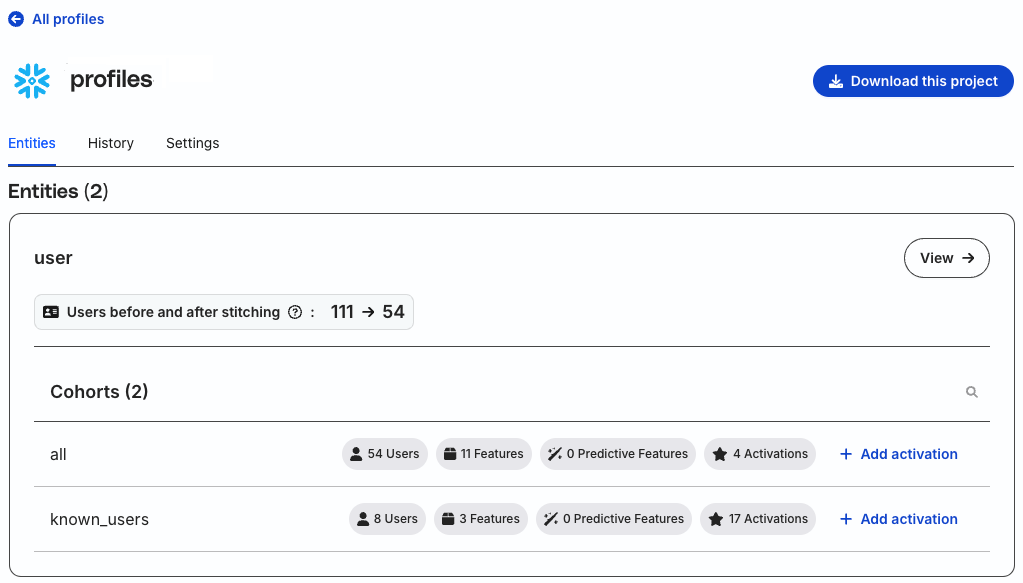
Contact the Profiles support team in RudderStack’s Community Slack if you are unable to see the Entities tab.
